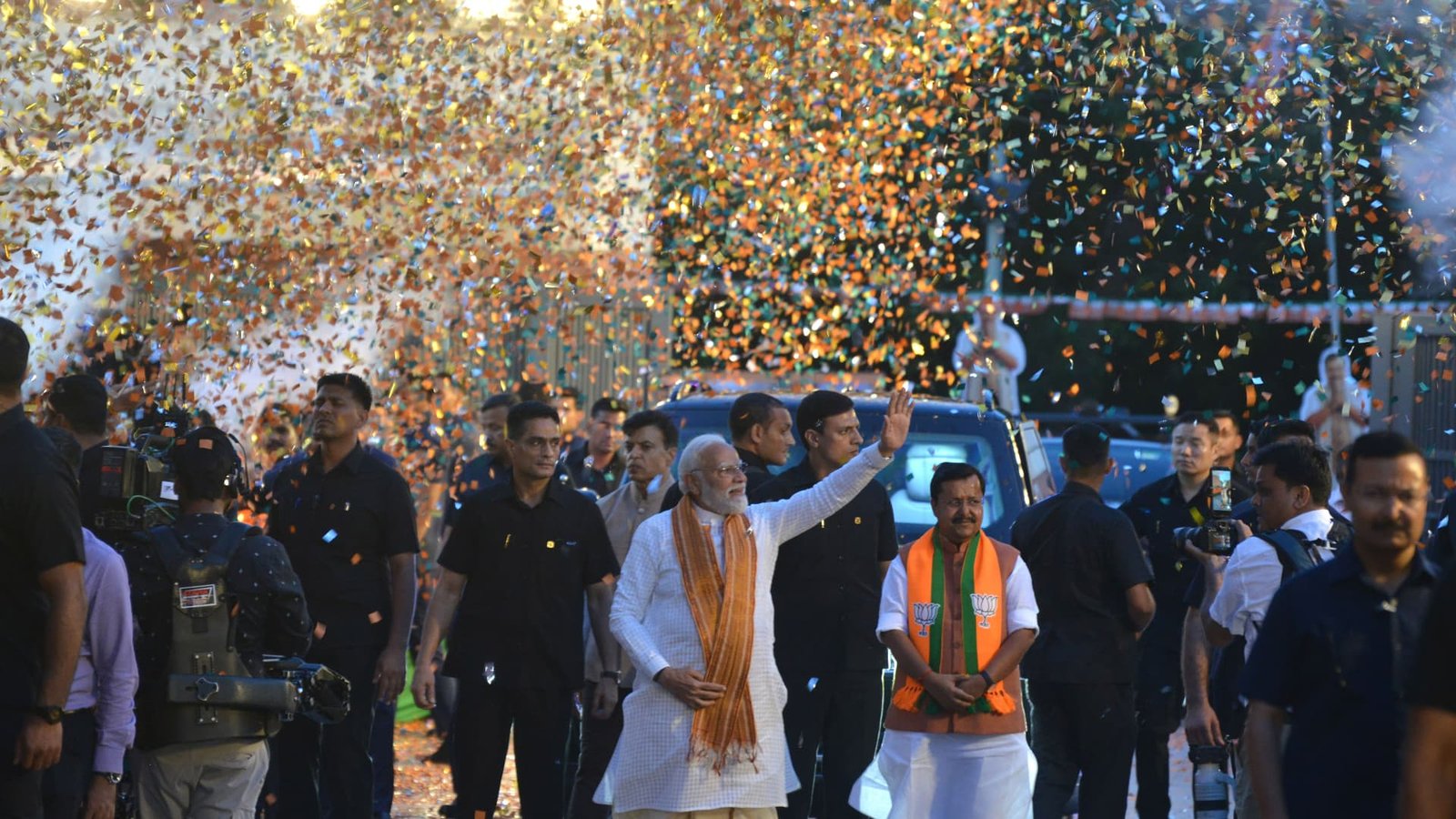
NEW DELHI, INDIA – MAY 04: Bharatiya Janata Party (BJP) leader and Indian Prime Minister Narendra Modi (C) greets people as he arrives at the party headquarters to deliver a victory speech, in New Delhi, India on May 04, 2026. The BJP has emerged victorious in the tally of the West Bengal and Assam state assembly election results. (Photo by Imtiyaz Khan/Anadolu via Getty Images)
Anadolu | Anadolu | Getty Images
Indian Prime Minister Narendra Modi’s Bharatiya Janata Party achieved a historic election win in West Bengal on Monday, strengthening its grip on power as the country grapples with economic challenges and a pressing need for reforms.
Modi’s popularity was seen to be waning when, in June 2024, his party failed to secure an outright majority in the national polls and had to form a coalition government for his third term as prime minister.
Since then, the Indian government has been spending money on populist welfare schemes and, more recently, on fuel subsidies, but reinforcement of Modi’s political popularity could provide room to rationalize some of that spending, experts said.
The latest results of state polls have dispelled worries of Modi losing political momentum as the BJP won 206 seats out of 294 in West Bengal, forming its first-ever government at the state level.
In a post on X following the results, Modi declared: “The Lotus Blooms in West Bengal!” a nod to his party’s symbol. “People’s power has prevailed and BJP’s politics of good governance has triumphed,” he said.
Out of the 11 state elections since 2024, the BJP and its allies have retained power in four states and gained power in two others, reflecting “continued popularity of PM Modi and his party,” global brokerage Citi noted in a note on Monday.
“Markets would hope that a strong political mandate and easier coordination with state [governments] will facilitate better implementation of various policy and process reforms,” Citi said.
Impact of Iran war
The Indian government has been reluctant to pass on the rising energy costs to consumers and has instead taken a “huge hit” on tax revenues by cutting the central excise duties on fuel to prevent pump prices from rising.
Alongside the fuel subsidies, the government has also been spending money on populist measures. More than a dozen Indian states plan to spend up to 2.5 trillion rupees ($26.2 billion) or 0.5% of GDP on unconditional cash transfers to eligible women to help cover household expenses, Bernstein Research said in a report on April 23.
“The win certainly strengthens the government politically to take tough decisions in a time of economic crisis caused by the Middle East war,” said Ashok Malik, partner at public policy think tank The Asia Group, on a call with CNBC.
The government will have room to undertake a “price rise” of energy products, he said, adding that rationalizing some of the populist spending or welfare spending will also be on the agenda.
But more needs to be done to speed up reforms addressing the economy’s underlying weaknesses, as prolonged delays are pushing foreign investors toward alternative markets, according to experts.
Need for reforms
Morgan Stanley, in an April 22 report, said that India’s net foreign direct investment flows are “near all-time lows of $0.5 billion” in the 12 months ending January 2026. The bank said the trend is likely to continue.
Foreign portfolio investors, too, are exiting India’s equity markets in record numbers. Since January this year, they have sold Indian stocks worth more than $20 billion, exceeding the $18.9 billion sold in all of 2025, as per data from central depository NSDL.
The rising fuel costs and the exodus of foreign investors have weakened the rupee against the dollar, sending it to record lows and deepening economic woes.
Meanwhile, India’s white-collar jobs in the information technology sector are shrinking as global artificial intelligence tech advances, and manufacturing jobs have not scaled up enough. Up to 45% of India’s population continues to depend on agriculture, a sector that contributes only 15-16% to the economy.
The government’s last attempt to reform farming failed in 2021, after facing intense protests from farmers.
“Having dominance over the electoral map necessarily translates into faster reforms,” said Shumita Sharma Deveshwar, chief India economist at financial analysis firm GlobalData TS Lombard, adding that “India really only reforms when it is in a crisis.”
For now, the election victory in state polls gives the BJP and its allies close to two-thirds majority in the upper house of the parliament, but it still lacks the strong mandate needed to pass tougher reforms in the lower house, according to the experts CNBC spoke to.