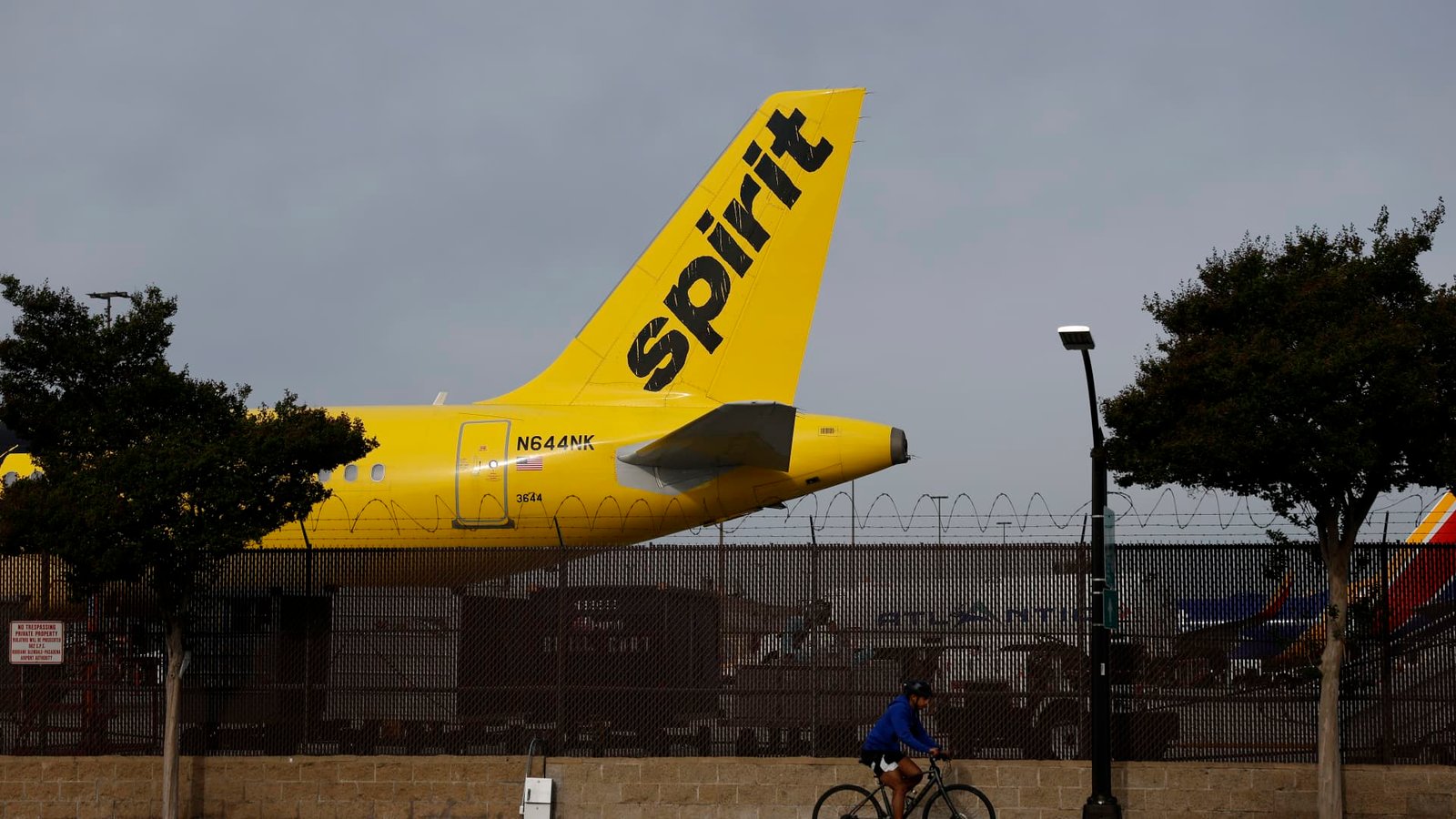
A Spirit Airlines plane sits parked at Hollywood Burbank Airport in California, April 16, 2026.
Justin Sullivan | Getty Images
Spirit Airlines struggled for years, battered by larger, cash-rich airlines that copied its business model as well as by failed mergers, higher costs and, most recently, a surge in jet fuel prices because of the war in Iran. It then faced the most unforgiving foe: time.
“We just kind of ran out of runway,” CEO Dave Davis said in an interview with CNBC on Monday.
Spirit had hoped to exit bankruptcy, its second in less than a year, in mid-2026. Four days before the U.S. and Israel attacked Iran, a conflict that has sent fuel prices skyrocketing, Davis said he and his team were optimistic that the exit strategy could still work. But that was contingent on fuel prices moderating in April.
They didn’t.
“Late March, early April, it became clear that it was going to be tough for us to get through,” Davis said, noting that crude oil prices were above $100 a barrel.
Time’s up
Other airlines leave printed instructions for travelers affected by the Spirit Airlines shut down at LaGuardia Airport’s Marine Air Terminal in New York on May 2, 2026.
Leslie Josephs/CNBC
To try to save the company from collapsing, Davis and others inside Spirit talked to the Trump administration about a bailout.
“We got connected with some various folks in government, including [Commerce] Secretary [Howard] Lutnick, through some contacts,” he said. “These guys … particularly Commerce, very eager to help.”
The Trump administration had been working on an offer for a $500 million loan to keep the airline afloat in a plan that could have given the U.S. government an up to 90% stake in the carrier. Bondholders weren’t on board and floated a counter proposal.
“Our bondholders also worked very hard to try to get something done,” Davis said.
The two sides were far apart on deal terms and it was clear by Thursday that it wasn’t going to work.
“I think we just ran out of time,” he said.
Spirit said some 17,000 people, both direct and indirect airline workers, lost their jobs in the airline’s collapse. Other carriers, smelling blood, had been circling for nearly a year if not longer, and within hours of the airline’s collapse were scrambling to both fly ticketed Spirit customers and add to their schedules in the absence left by Spirit’s yellow planes.
What’s next?
A Spirit Airlines poster on a LaGuardia Airport shuttle bus the day the airline shut down.
Leslie Josephs/CNBC
Spirit hired longtime airline executive Davis, most recently chief financial officer at Sun Country, in April 2025, about a month after the company zipped out of its first bankruptcy. Critics said it avoided bigger changes in that first bankruptcy, like shedding more assets to get costs down.
Last August, the airline filed for Chapter 11 bankruptcy protection again, facing many of the same problems, though it had slashed flights, gotten rid of some of its Airbus jets and furloughed crew members to save cash.
Davis previously worked at Northwest Airlines, which combined with Delta Air Lines in 2008, and also worked at US Airways, which merged with American Airlines in 2013. Along with United Airlines and Southwest Airlines, the four airlines control about 80% of U.S. capacity, after a major wave of consolidation.
More consolidation is likely and “what the lower end of the industry needs,” Davis predicted. He said if Spirit’s planned acquisition by JetBlue Airways wasn’t blocked by a judge two years ago, “I believe that we wouldn’t be in the situation we are right now.”
Low-fare airlines for a time were a headache for big legacy carriers, since they swooped into markets and offered eye-catching fares.
“There was no better exemplar of that than Spirit,” Davis said.
But then the big airlines started to copy some of the budget model, offering no-frills basic economy tickets and other add-on fees. That hurt carriers like Spirit, which was profitable in the 2010s but hadn’t turned a profit since 2019.
“Everybody saw the low-cost airlines just taking massive share,” he said. “The shoe was completely on the other foot then, than where it is today.”
He said another benefit the larger airlines have is their huge credit card programs, in which they earn money from banks when customers swipe their credit cards, a business that gives them a bigger cash cushion to weather shocks like high fuel prices.
Davis said in Spirit’s final days he was between Washington and the company headquarters in Dania Beach, Florida, trying to get to a deal. Some staff members, including pilots, didn’t get final word about the airline’s last flights until they were getting close to landing Friday night or early Saturday.
“You can’t announce ahead of time that you’re going to shut down,” he said. “What happens is vendors stop working. Fuelers stop fueling. Some crew members probably don’t come in. So then you’ve got airplanes and people and passengers scattered all over the place in foreign countries. It needs to be done in a very orderly way, and it needs to be done all at once.”
Davis said he is staying on at Spirit to oversee the airline’s closure. Leased planes will go back to lessors. Owned ones will get sold. Gates will be overseen by airports and likely used by other airlines. About 130 other employees are set to stay on for that work as well.
When asked if he would stay in the industry, Davis said: “I just love airplanes, and I like the industry, so I’ll probably never leave it, although sometimes it’s very trying and taxing on a person.”