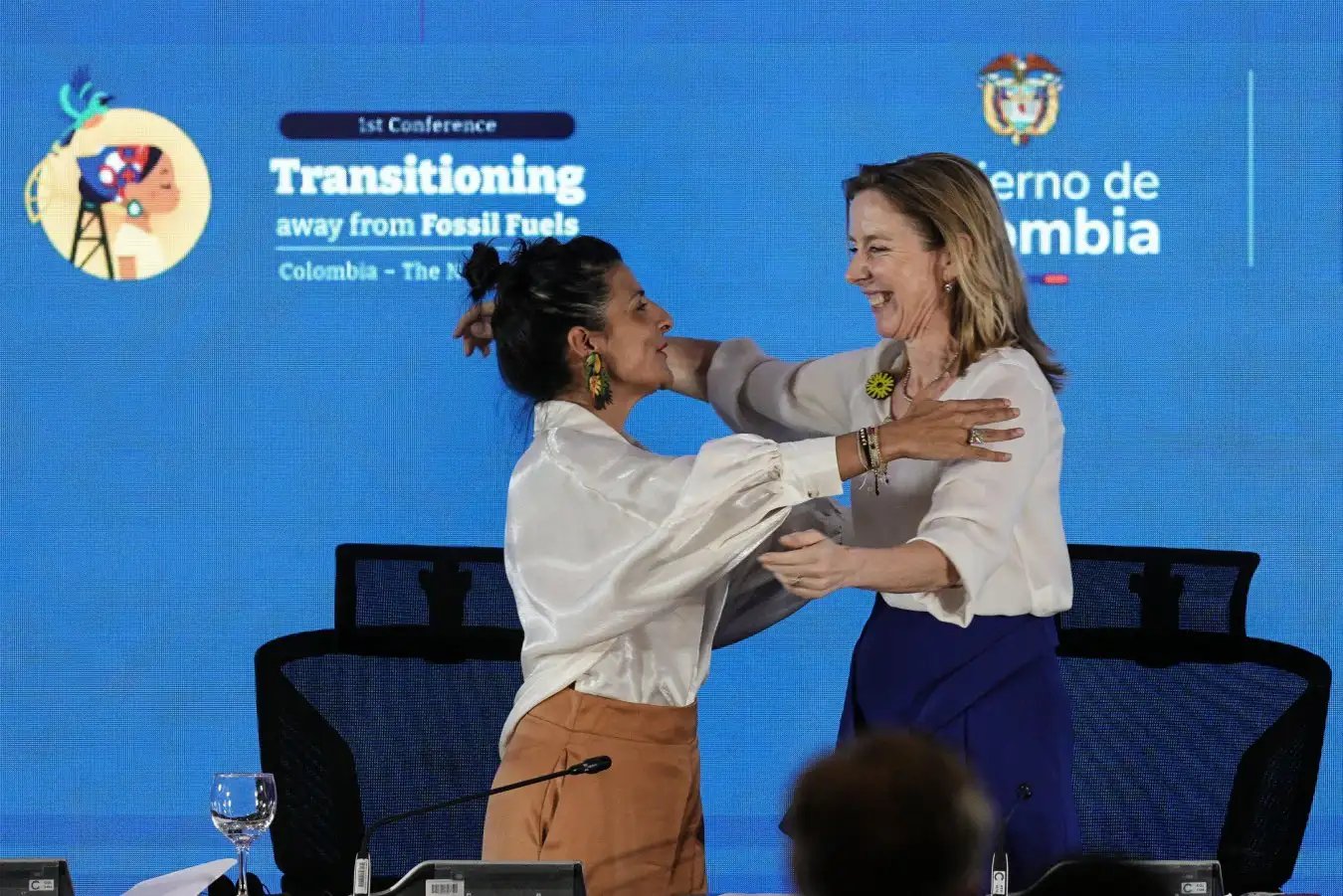
Irene Velez Torres and Stientje van Veldhoven, ministers from Colombia and the Netherlands, embrace at the end of the conference in Santa Marta, Colombia
Ivan Valencia/Associated Press/Alamy
When almost every country met in Brazil last November for the annual United Nations climate summit COP30, hopes were high they would draft a roadmap for the “transition away from fossil fuels” they previously called for. But the objections of petrostates prevented the final text from even mentioning fossil fuels.
In response, Colombia and the Netherlands hosted a conference this week on the transition away from fossil fuels, inviting 57 countries to the coal-exporting port of Santa Marta in Colombia. This “coalition of the willing” included climate stalwarts like the European Union and the UK, but also major oil exporters like Canada, Nigeria and Norway.
The summit sent a message that countries should double down on renewables rather than fossil fuels in response to the energy crisis sparked by the Iran War. It represented a step toward figuring out how to actually do that, although some observers doubted that words alone could break the gridlock on international action.
Johan Rockström at the Potsdam Institute for Climate Impact Research in Germany, who launched a science panel to advise participants on the transition, says the meeting was “not about negotiations, not about debating whether or not we have a problem, but focused entirely on how to accelerate and move forward on the phase-out of fossil fuels”. “This is clearly a first attempt of really moving forward on implementation,” he says.
Although twice as much global investment is going to low-carbon energy as fossil fuels, the boom in renewables has mostly met increasing electricity demand, rather than displacing oil, gas and coal. The world is currently on track for catastrophic warming of more than 2°C by 2100.
The summit’s participants will work on national roadmaps to transition away from fossil fuels ahead of a follow-up conference next year hosted by the Pacific island nation of Tuvalu, with a pre-conference in Ireland.
Although voluntary, these roadmaps are intended to incorporate not only the fossil fuels that a country consumes at home, but also those it exports abroad, which aren’t typically included in COP climate targets.
In Santa Marta, prominent academics unveiled a roadmap for Colombia to cut energy emissions by 90 per cent by 2050, which they said could ultimately bring economic benefits of $280 billion.
Also at the conference, France became the first high-income country to issue a roadmap away from fossil fuels, outlining measures to expand public transport, electric vehicles and heat pumps while scaling up solar, wind, hydro and nuclear energy.
While it did not appear to contain new policies, it set a deadline to end all fossil fuel energy, which would see a cutoff of coal consumption by 2030, oil by 2045 and gas by 2050. Many countries only have timelines to net zero, which can include fossil fuel emissions compensated by carbon capture or carbon credits.
The conference will also work to root out fossil fuel preferences in the financial system, such as government hydrocarbon subsidies and the debt crisis that encourages low-income countries to drill for oil and gas rather than build capital-intensive renewables.
“There is a pathway that could be developed to stop subsidising fossil fuels and redirect those funds” towards accessible climate finance, says Jeni Miller at the Global Climate and Health Alliance. “That’s only going to happen if enough countries are actually having the conversation around what needs to change.”
Simon Sharpe at the think tank S-Curve Economics, who negotiated for the UK at COP26, says the focus on debt is much-needed, but a fossil fuel roadmap is worth little as long as someone is willing to buy a nation’s oil and gas. Rather than promising to somehow curtail fossil fuel supply, countries should develop incentives to decarbonise lagging industries like steelmaking, he argues.
“Diplomacy can help, but it needs to be focused on the right things and it needs to have the right participants,” Sharpe says, noting that major growing economies like China, India and South Africa were not invited to Santa Marta.
The ultimate value of the conference will be determined by how much of its ambition the participants can translate into the agreement negotiated at COP31 in Turkey, says Joanna Depledge at the University of Cambridge.
“Do you just preach to the converted?” she says. “Or do you just try even harder to get some kind of consensus in the COP? Because that is sort of the value of the COP, is that you genuinely do engage absolutely everybody, including the fossil fuel exporters.”
Topics: