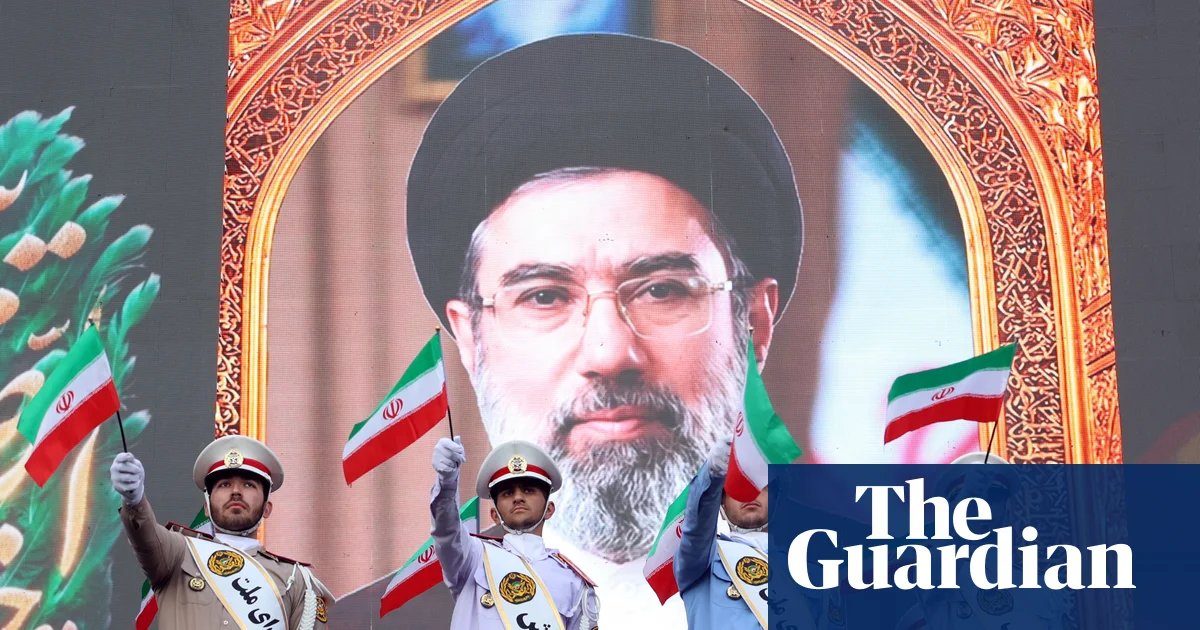
Iran’s supreme leader has broken his recent silence with a defiant statement hailing Iran’s control over shipping in the strait of Hormuz and vowing to guard the country’s nuclear and missile programmes.
“Today, two months after the largest military deployment and aggression by the world’s bullies in the region, and the United States’ disgraceful defeat in its plans, a new chapter is unfolding for the Persian Gulf and the strait of Hormuz,” Mojtaba Khamenei said in a statement read by a state television anchor.
The statement said Tehran would secure the Gulf region and eliminate what he described as “the enemy’s abuses of the waterway”, and that “new management of the strait will bring comfort and progress for the benefit of all the nations of the region and economic blessings will being joy to the hearts of the people”.
Iran has sought to extract a price for being attacked by exerting control over the strait, the narrow waterway through which about one-fifth of global oil typically transits.
Khamenei also vowed that Iran would “guard its modern technological capacities – from nano to bio to nuclear and missile – as their national capital and will guard it like their maritime land and air borders”.
No recording or visual sighting of Khamenei has been broadcast since he was appointed supreme leader in early March. Reports have suggested that he was severely injured in the bombing that killed his 86-year-old father and predecessor on 28 February. He is said to be in hospital being treated for injuries.
His new statement suggests Iran is determined to implement a new fees regime in the strait that it will present as benefiting the entire region as a belated assertion of regional sovereignty.
Since 13 April the US has mounted a counter-blockade designed to stop oil tankers moving in or out of Iranian ports, ultimately seizing up the Iranian oil industry.
With Pakistan-mediated talks at an impasse, there is little sign of either blockade being lifted, pushing the oil price above $120 a barrel. Vessel traffic levels are still extremely low, sometimes as low as three ships a day compared with 120–140 in normal conditions.
“Foreigners who maliciously covet it [the strait] from thousands of kilometres away have no place there except at the bottom of its waters,” Khamenei’s statement said.
The strait’s closure has put pressure on Trump, as oil and gasoline prices have rocketed before crucial midterm elections, and his Gulf allies, which use the waterway to export their oil and gas.
Trump’s admission on Wednesday that he knew no short way out of the impasse pushed oil prices close to $125 a barrel – as high as during the first weeks of Russia’s full-scale invasion of Ukraine in 2022.
The Axios news website reported that the US military was still feeding Trump options to resume strikes.
Maj Gen Mohsen Rezaee, the military adviser to the supreme leader, wrote on his X account: “The siege scenario will fail and Iran will never lose the strait of Hormuz. History will record that the Iranian nation sank the superpower of America in the Persian Gulf and the Sea of Oman. Both the field and diplomacy are moving forward with the coordination of the leader of the revolution and the support of the people”
The world considers the strait an international waterway, open to all without paying tolls, and Gulf Arab nations, chief among them the United Arab Emirates, have decried Iran’s control of the strait as akin to piracy.
Iran has proposed that talks with the US on its nuclear programme be parked while both sides agree terms for allowing ships to resume passage along the strait. Inside Iran the foreign ministry has urged the parliament to recognise that Iran’s plans being hatched in conjunction with Oman do not require fresh Iranian legislation. It is also urging that Iran avoid terms like tolls, and instead assert its pre-existing right to charge fees for services rendered.
The US secretary of state, Marco Rubio, and the UK foreign secretary, Yvette Cooper, held talks in Washington on Wednesday about the strait. An email sent by the state department to embassies reported by the Wall Street Journal suggested the US was trying to become involved in largely European-led plans for the oversight of the strait once the conflict ends.
The US is offering to coordinate diplomacy and communications between nations using the strait by reviving and broadening a 12 nation International Maritime Security Construct, a pre-existing naval operation set up in after threats to shipping by the Iranian navy.