
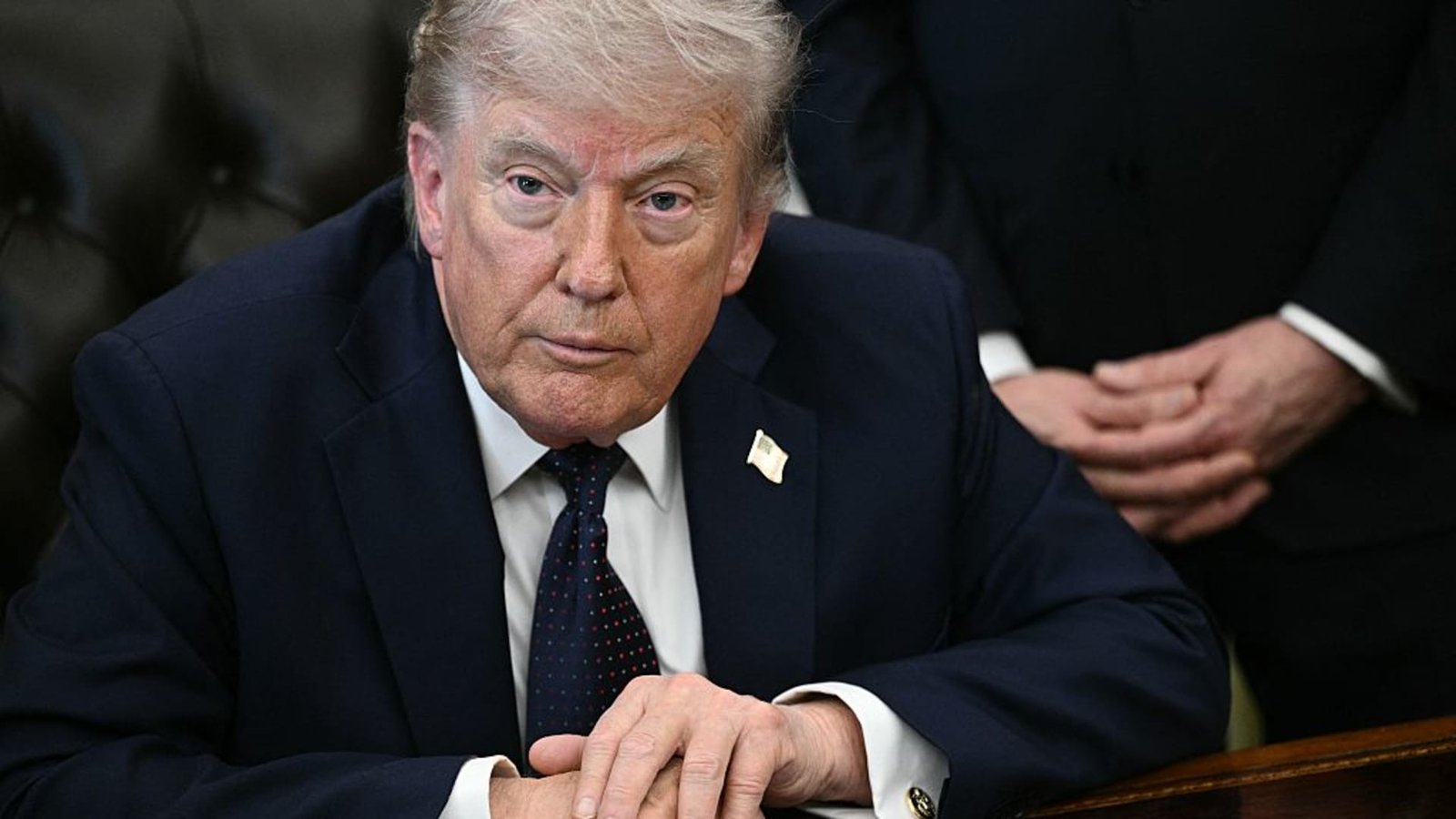
US President Donald Trump looks on during a meeting with Lebanon’s Ambassador to the US, Nada Hamadeh Moawad, and Israel’s Ambassador to the US, Yechiel Leiter, at the White House in Washington, DC on April 23, 2026.
Brendan Smialowski | Afp | Getty Images
The U.S. is being “humiliated” by the Iranian regime, Germany’s chancellor has said, as disquiet among European leaders over a prolonged conflict in the Middle East gradually intensifies.
“The Iranians are obviously very skilled at negotiating, or rather, very skillful at not negotiating, letting the Americans travel to Islamabad and then leave again without any result,” Chancellor Friedrich Merz said on Monday.
“An entire nation is being humiliated by the Iranian leadership, especially by these so-called Revolutionary Guards. And so I hope that this ends as quickly as possible,” Merz added, speaking to students in Marsberg in Germany.
The comments were unexpected, but at least partially reflect frustration that the Iran conflict is undermining Merz’s government’s efforts to bolster Germany’s flagging economy.
Merz, like other European leaders, has faced criticism from President Donald Trump for a reluctance to participate in the war. Europe, already dealing with a four-year conflict on its doorstep in Ukraine, sees the military operation as a war of choice that it was not consulted on beforehand.
Leaders are also worried that the U.S. has underestimated the resilience of the Iranian regime, which is underpinned by the Revolutionary Guard, and fear the war could turn into another so-called forever war in the Middle East.
“The problem with conflicts like these is always the same,” Merz noted Monday: “It’s not just about getting in; you also have to get out. We saw that all too painfully in Afghanistan, for 20 years. We saw it in Iraq.”
Europe’s patience wanes
Merz’s concerns are shared by other European officials who have expressed a reluctance to get “dragged into” the war, as British Prime Minister Keir Starmer put it. French President Emmanuel Macron and Italian Prime Minister Giorgia Meloni have also voiced their misgivings over the war, while Germany’s defense minister has previously called it a “catastrophe.”
Former NATO chief Jens Stoltenberg, the current finance minister of Norway, told CNBC that wars are dangerous and escalation was still a distinct possibility while peace talks remain in a period of stalemate.
“I worry most about the fact that, of course, wars are dangerous,” Stoltenberg told CNBC’s Ben Boulos on Monday.

“We have a war in Iran, the Middle East, and then we have a full-scale war in Europe, in Ukraine, and of course, wars are unpredictable. They can escalate, and if that happens, it will be first and foremost about human suffering, but it will have even bigger economic consequences than the consequences we have seen so far financially,” he warned.
The Iran war hits net energy importers like the European Union and U.K. hard because it has meant they’ve been forced to bolster oil and gas supplies from producers outside the Middle East like the U.S. and Norway. The EU used to import a significant amount of oil and gas from neighboring Russia, but those imports were banned due to the war in Ukraine.
There is increased competition and demand for alternative fossil fuel supplies and prices have risen dramatically. Last Friday, European Commission chief Ursula von der Leyen said the EU has had to pay 25 billion euros ($29.2 billion) more for oil and gas imports since the start of the Iran war.
Last week, Macron blamed both the U.S. and Iran for the ongoing blockade of the Strait of Hormuz and called for a “return to calm,” French news agency France 24 reported.
Stalled talks, but an offer
U.S. negotiators were due to travel to Islamabad in Pakistan for more talks last weekend, but Trump canceled the trip.
“We have all the cards,” the president told Fox News, adding that if Iran wanted to talk, “they can come to us, or they can call us.” Previous negotiations led by Vice President JD Vance also ended without a deal.
A man reads newspapers at a roadside stall in Islamabad on April 25, 2026. US envoys headed to the Pakistani capital on April 25 in a bid to kickstart a new round of peace negotiations with Iran amid a fragile ceasefire, though the prospect of direct talks remained uncertain. (Photo by Asif HASSAN / AFP via Getty Images)
Asif Hassan | Afp | Getty Images
Tehran has proposed that it would reopen the Strait of Hormuz if the U.S. lifts its ongoing blockade of Iranian ports and the war ends, White House press secretary Karoline Leavitt confirmed on Monday.
The proposal would postpone negotiations on Tehran’s nuclear ambitions for a later date, Axios and The Associated Press reported earlier on Monday. Reuters reported earlier Tuesday that Trump was not happy with the Iranian proposal, and the White House is expected to return with a counteroffer in coming days.

