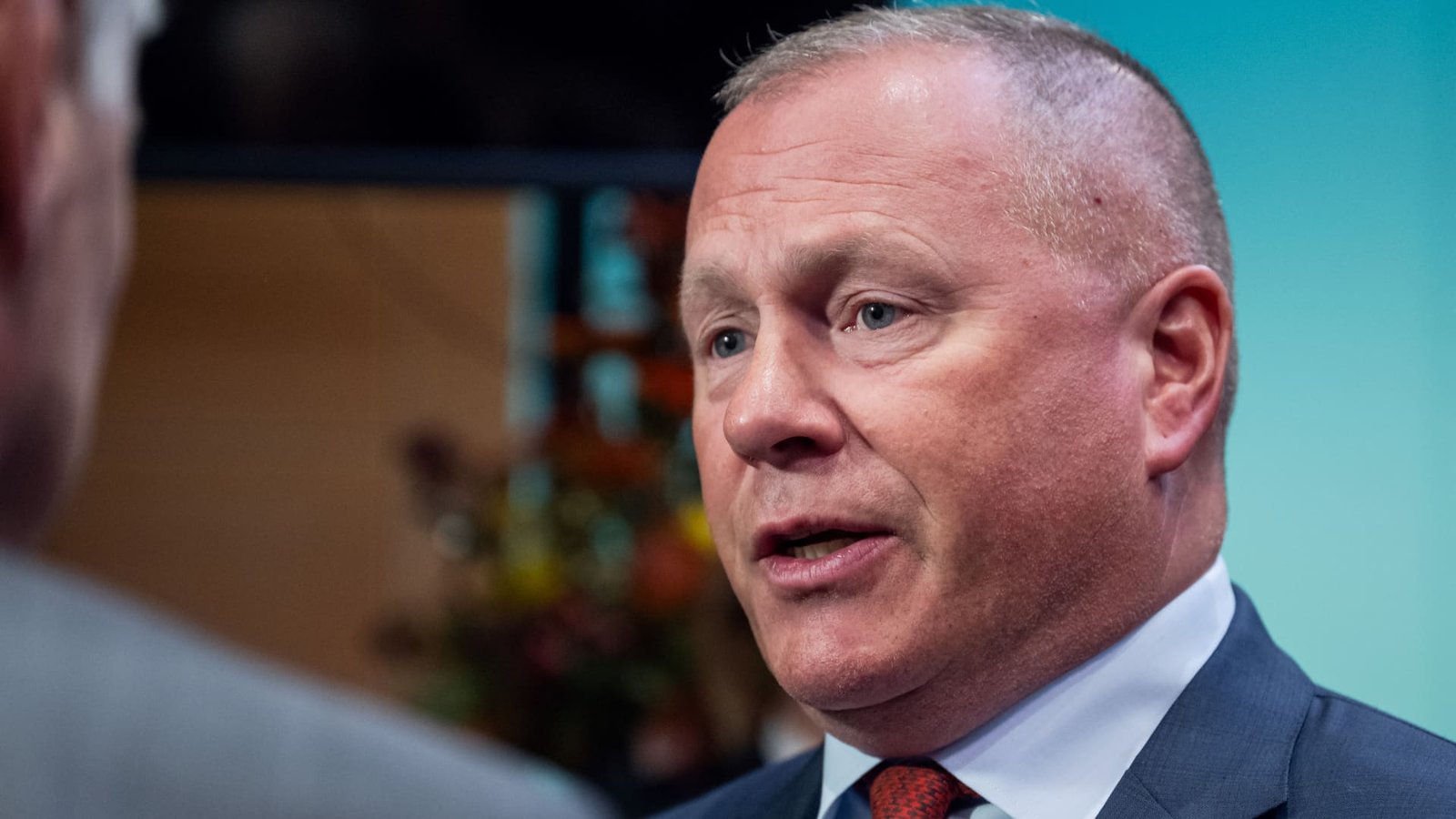
Stock markets have been largely buoyant since the end of March after bouncing back from a sell-off sparked by the outbreak of the U.S.-Iran war, but one of the world’s biggest investors is glad not to be buying individual names. Speaking to CNBC’s Ben Boulos on the sidelines of the sovereign wealth fund’s annual Investment Conference in Norway, Norges Bank Investment Management CEO Nicolai Tangen said global markets are “in a period where it’s very good to be an index fund.” NBIM manages Norway’s $2 trillion sovereign wealth fund, the largest of its kind in the world. “What’s happening with AI and technology and so on is deflationary and it’s positive for the markets, but it’s difficult to know exactly how you’re going to navigate the market,” Tangen said. “So in a way, I’d rather be invested in the whole market at this stage, rather than trying to pick individual stocks.” Global stocks were volatile in the immediate aftermath of the U.S. and Israel’s first strikes on Iran in late February, but have since shown resilience with many major indexes recouping losses incurred earlier on in the war. The Norwegian sovereign wealth fund’s performance since the Iran war began is not publicly available information, but any returns would build on the near $250 billion profit NBIM made in 2025. Formally known as the Government Pension Fund Global, the wealth fund is given guidelines from the Norwegian government on where it can invest. It invests only in overseas assets, to stop the Norwegian economy from overheating and is measured against a benchmark index set by the Ministry of Finance. Given the geopolitical and macroeconomic backdrop, Tangen said the “clear mandate from the ministry is a very good thing to have” right now. But, he conceded, the fund will take a hit in the event of a market correction. “We are an index-near fund, and that means that you participate in the in the upturns and you participate in the downturns, and that’s the way you have to be positioned as a long-term investor,” he said. “We invest with a very, very long-time horizon. We are broadly diversified across the whole world. We own 7,000 companies — and so for sure, if markets go down, we’ll go down too.” If markets go down, we’ll go down too CEO, NBIM Nicolai Tangen Set up in the 1990s to invest revenues from Norway’s oil and gas industry, Norway’s sovereign wealth fund is currently valued at around $2.2 trillion. It invests in roughly 7,200 companies across 60 countries and has stakes in around 1.5% of the world’s publicly listed stocks, making it one of the biggest individual investors in the global stock market. With the Iran war, and the effective closure of the Strait of Hormuz, creating oil supply constraints, Norway’s pension fund has seen boosted inflows. Norway — western Europe’s biggest petroleum producer — has seen rising demand for its energy resources, with crude oil exports jumping 12% in the year to March, official data showed this month. But Tangen struck a cautious tone when discussing the state of the market, stressing that “the outlook is very uncertain” as the U.S.-Iran war reached the two-month mark. “The companies which have reported so far this season, a lot of them… [are] very uncertain what the outlook is going to be on the back of what’s going on in the Middle East,” he said. “We are seeing, of course, consequences in the energy market. We are seeing more consequences in Asia. We expect that to move into Europe and then subsequently into the U.S., and potentially lead to higher prices.” NBIM’s equity portfolio, which makes up 71% of all its investments, is heavily skewed toward the U.S., with American stocks accounting for nearly 40% of the fund’s holdings. With significant stakes in companies including Nvidia , Apple and Microsoft , NBIM is influential in terms of voting power and setting market trends. ‘Phenomenal’ AI will not replace human investors In the wide-ranging interview, Tangen also discussed how NBIM was “all over” incorporating artificial intelligence into its daily operations. Earlier this year, NBIM told CNBC the fund’s management team was using Anthropic’s Claude AI model to screen its investments. “We have been really pushing this for the last three years,” Tangen said on Tuesday. “We are talking about it every time we get together, it impacts the way we recruit, we’ve got ambassadors across the firm, we’ve got events across the firm, we have kind of forced training schedules, we’ve got AI teams — I mean, we are just all over it, and we are seeing that the effects really coming through.” Over the last year, he said, NBIM has become around 20% more productive thanks to AI. “The use of AI is generating huge savings in our trading costs, because we can internalize more of the trading that we do, so we don’t have to put it out to the market,” Tangen told CNBC. “I would say it impacts pretty much everything we do, and it’s a phenomenal thing.” However, he stressed that AI is not used to make investment decisions at NBIM. “We always have a human in the loop, and so [AI] does not make autonomous decisions,” Tangen said. “I can’t really see that happening here, of course there are a lot of [companies] where that’s now already taking place, but we are not doing it.”