
When the late and great Times sports columnist Mike Downey decided years ago to write about jockey Billy Shoemaker, he did so perfectly. His lead sentence:
“Billy Shoemaker was born 2 pounds 6 ounces and it was the only edge he ever needed in life.”
That remains noteworthy now, because when they run this year’s thoroughbred classic at Churchill Downs on May 2, it will mark 40 years since “Billy The Shoe,” still the third-winningest rider in the sport’s North American history and perhaps its most memorable, won his fourth and last Derby aboard a 17-1 longshot named Ferdinand.
In 1986, Snow Chief was the 3-1 Derby favorite. He was trained by colorful and often grumpy Mel Stute, who was, like Shoemaker, a fixture at Santa Anita. His jockey was a young Alex Solis, who came from Panama, was still struggling with the English language then and had quickly dazzled the Southern California racing world with his talent.
Jockey Bill Shoemaker smiles as he holds a large plaque presented to him at Santa Anita on Jan. 1, 1953, in recognition of winning 484 races. He promptly added to the total by winning the first race of the day.
(David F. Smith / Associated Press)
It was an era in sports somewhat less contentious, more inclined to celebrate its history and its moments and less inclined to look for more. A few weeks earlier, Jack Nicklaus had won the Masters, at age 46. It was a hugely popular outcome, just as Shoemaker’s would be. It was quite the time for legend building, those few months in 1986.
The Derby network telecast brought the comfort of an easy chair. Jim McKay, who had done it for years, took viewers through the likely race scenarios. Al Michaels, whose racing chops were notable well before he asked the world if it believed in miracles and well before the NFL hustled him away to greater fame and fortune, pitched in on the telecast with thoughts on the pageantry and some race angles. A young Michaels, with thick black curly hair and the same distinctive voice, broadcast from the track and touched on the interesting elements of Shoemaker’s presence.
“Ferdinand is at 17-1,” Michaels told the audience. “A few years back, you couldn’t get 17-1 with Shoemaker if he was riding Mr. Ed.”
Shoemaker was already a legend and had already won the Derby three times by then. But any mention of his Derby expertise was, and always would be, sprinkled with a disclaimer about his 1975 ride on Gallant Man, when he misjudged the finish line while leading on the home stretch, pulled up his horse and lost a race he had pretty much won.
In ‘86, that was all soft peddled by the media, which mentioned it more out of duty than reportorial necessity. Ferdinand was, after all, a 17-1 longshot, easier to downplay or ignore. Also, Shoemaker was 54, not exactly an age to be looked upon as a contender. No jockey that age had ever won the Derby — and still hasn’t. There was respect for his seniority, but mostly an assumption that he was the past, not likely the present. He had led North American racing in victories for 29 years, finally totaling 8,833. But much of that happened prior to 1986.
Worst for Shoemaker, he had drawn the No. 1 hole, the starting spot closest to the infield that is usually a death knell for Derby horses. The gate opens and the entire field dashes for the rail, all coming down on top of the 1-hole starter. Shoemaker and Ferdinand held ground for a while, but by the time they got to the back stretch, they were dead last. They were still there as the field got to the top of the home stretch.
Then the cavalry charge to the finish began and Shoemaker went with the crowd, to the outside. At one point in the home stretch run, he was six horses wide.
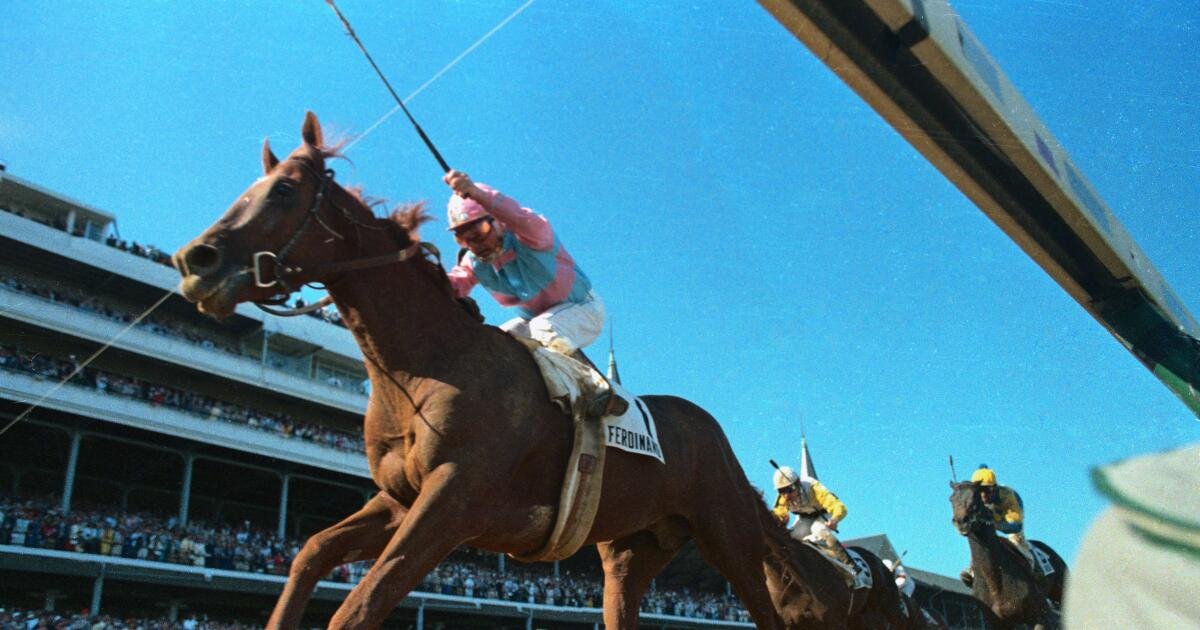
Then, he made one of those moves that made William Lee Shoemaker “Billy The Shoe.” He saw an opening to his left, squeezed through it and soon had Ferdinand almost to the rail — and in full gallop. Before anybody could analyze what had happened, Ferdinand, carrying a jockey who probably never weighed 100 pounds in his career — thanks to the birth advantage Downey so aptly pointed out years later — was cruising past the leaders and sailing home a winner.

Ferdinand, ridden by Billy Shoemaker, heads down the homestretch to win the Kentucky Derby on May 5, 1986, in Louisville, Ky.
(John Swart / Associated Press)
The victory made legendary trainer Charlie Whittingham a Kentucky Derby winner for the first time. He was 73 and had disliked running young horses in a pressure race such as the Derby. The Triple Crown races are only for three-year-old thoroughbreds. Whittingham won another Derby three years later with Sunday Silence. He trained into his 80s.
Shoemaker’s career rightfully was topped off by that Derby victory, as well as his win in the Breeders’ Cup Classic in 1987.
The aftermath of that 1986 race was less kind, although nobody could take away what Shoemaker had accomplished. The jockey who finished last in the ’86 Derby was Laffit Pincay Jr., who later passed Shoemaker’s North American victory total with 9,530 wins. Pincay’s total was topped by Russell Baze, who took 12,842 wins, but in a riding career that featured wins at lesser tracks against lesser competition. When Baze broke his record, however, Pincay was there to offer his congratulations.
By the time Shoemaker won the 1986 Derby, he had little left to achieve. He not only won 11 Triple Crown races, but he also had won, to mention a few prestigious races, the Hollywood Derby, the Hollywood Gold Cup, the Oak Tree Stakes, the San Luis Obispo and the Santa Anita Derby.

Jockey Billy Shoemaker smiles as he rides Ferdinand, the 1986 Kentucky Derby winner, at Hollywood Park after winning the Breeder’s Cup.
(Bettmann Archive via Getty Images)
Each one eight times.
Shoemaker moved into thoroughbred training after he stopped riding. He was a fixture around Santa Anita, as he had been as a jockey. His success was mixed, certainly less than he had as a jockey.
On April 8, 1991, after a day of golf in the Inland Empire, Shoemaker was headed west on the 210 freeway in San Dimas. The road at that point includes an exit to the right for the 57 freeway south and under the 210. Shoemaker swerved right off the 210 and rolled his Ford Bronco down the embankment, about three stories high, and onto the 57 freeway. Police confirmed he was intoxicated during the crash. Shoemaker suffered a broken neck and spent the rest of his life in a wheelchair, from which he continued as a trainer for several years.

Billly Shoemaker is in the winner’s circle at Santa Anita in March 1976 after winning his 7,000th race.
(Associated Press)
Shoemaker eventually sued the state of California because there was no guard rail at the site, the Ford Motor Co., to whom he alleged that the Bronco was a rollover risk, and Glendora Community Hospital for alleged incorrect treatment when he was bought in. Ford paid him at least $1 million, after agreeing to do so if he received no money from the hospital. There is no record of him getting any money from the state of California.
Shoemaker died in October 2013. He remains third on the North American jockey career win list with his 8,833.
Ferdinand was sent to stud in 1989 and sold to a breeding farm in Japan in 1994. In 2002, reports surfaced that Ferdinand had been sent to a slaughter house in Japan, where he became food for either humans or pets, or both. Racing’s indignation over that, as well as that of anger in the general public, prompted the formation by Congress of a bill that would ban the slaughter of horses in the United States.
It never passed.


