
In 59 B.C.E. Julius Caesar, future dictator of Rome, gifted his favorite mistress Servilia a black pearl earring of such size and luster that it was chronicled by many Roman writers of the day.
Caesar reportedly paid six million sesterces (hundreds of millions of dollars today) for the gem, making it one of the most extravagant displays of affection the world has ever seen. Although the cost was exceptional, his gift of a pearl was not. After all, pearls were a cornerstone of ancient Rome’s political and economic power.
Cheaper imitations and modern methods of culturing have considerably diminished the value of natural pearls since then. But nacre, the lustrous substance mollusks use to line their shell, is becoming prized once more, this time in materials science.
On supporting science journalism
If you’re enjoying this article, consider supporting our award-winning journalism by subscribing. By purchasing a subscription you are helping to ensure the future of impactful stories about the discoveries and ideas shaping our world today.
Nacre’s internal nanoscale architecture holds huge promise for researchers as they rush to create nature-inspired materials for a transition to clean energy without cost to Earth.
Natural Ceramic
Nacre is a natural ceramic; its inorganic building blocks arrange themselves in a neat geometric shape. Synthetic ceramics have become the bedrock of modern life, and they are now found in everything from hip replacements to cell phone casings. Not merely strong, so-called advanced ceramics are inert and able to withstand wear, corrosion and high temperatures, making them extremely useful. But as anyone who’s dropped a mug knows, ceramics are also brittle and prone to smashing.
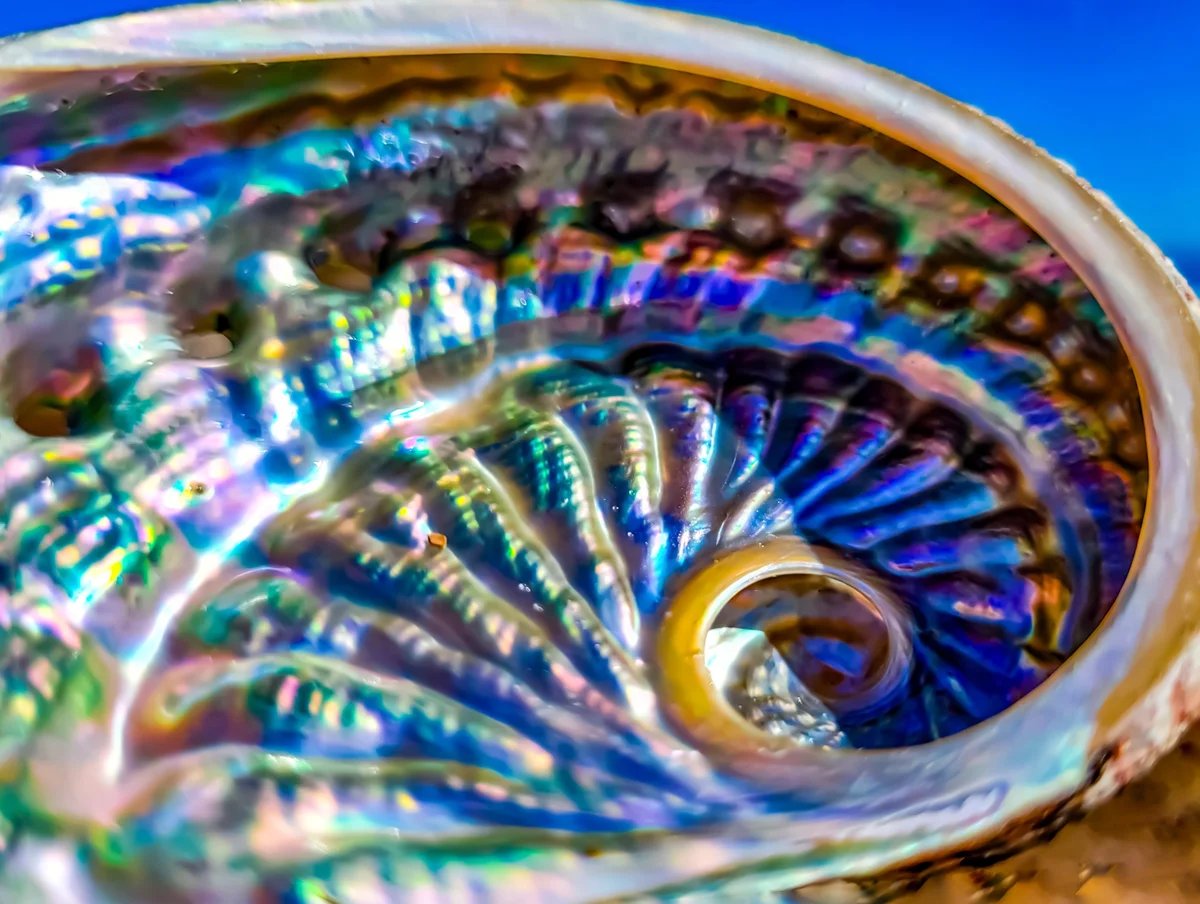
Pearls, on the other hand, are made by soft-bodied mollusks in reaction to an irritant that has entered their shell. As part of an immune response, the mollusk secretes mother of pearl (nacre) and coats the particle until it becomes smooth and relatively round. It’s easy to understand why the Romans were enthralled; the substance seems to capture light and disperse it in a muted glow of iridescence, an effect caused by crystalline layers that are roughly the same size as the wavelength of visible light. Incoming light waves refract and interfere with one another as they bounce off the internal structure. But it isn’t their beauty that captivates materials scientists.
“When we started to look at the microstructure of these natural materials, like bone and nacre, we find they are very, very tough,” says Eduardo Gutierrez, director of the Center for Advanced Structural Ceramics at Imperial College London. In Gutierrez’s field, strength and toughness mean very different things. Toughness is about how much energy a material can absorb by deforming plastically, while strength measures how much force a material can resist before it gives way.
Pure ceramics are strong but brittle. Nacre is both strong and tough. “Although nacre’s cells are essentially 99 percent ceramic by volume, it is resistant to crack propagation. And it has a very interesting microstructure,” Gutierrez says.
Specifically, nacre is composed of hexagonal crystals of aragonite, a kind of calcium carbonate that is also seen in limestone and that forms precisely into overlapping layers that resemble the brick-and-mortar structure of buildings. The layers overlap out of alignment so that the joints between individual crystals, or “bricks,” don’t line up, increasing the number of hydrogen bonds in the overall structure and conferring it with strength. But where limestone is crumbly and opaque, nacre’s toughness and light-bending properties come from silklike proteins that weave among the layers, holding them in place while providing enough elasticity to absorb the shock of a fracture. In fact, nacre is roughly 3,000 times tougher than its calcium carbonate building blocks.
Until recently the way these different elements interacted at the nanoscale during crack formation was a mystery. But electron microscopy and other novel tools have vastly expanded our understanding of the composition of nacre, revealing the layers of calcium carbonate to be exceptionally thin, with individual crystal “bricks” interlocking in a dovetail shape that increases friction in the system and resists horizontal forces. Even more impressively, when you stretch those silklike polymers, Gutierrez says, “they have a particular behavior: they become stiffer.”
Synthetic Nacre
But even with ever more detailed electron microscopy, nacre has proved very difficult to manufacture synthetically. “Nacre is 99 percent ceramic—it’s true,” Gutierrez says. “But that 1 percent organic glue is critical. It is difficult to weave in the right formation to replicate that structure.”
For modern high-performance structural uses, an exact replica of nacre might even be undesirable because those organic silk proteins would lose their structure at high temperatures. That’s why many material scientists are instead trying to replicate nacre’s internal architecture with different building blocks. Researchers are testing some of these nacre-adjacent ceramics in next-generation nuclear reactor plants, where high resistance to fracturing is essential to prevent catastrophic failure under extreme thermal stress.
There’s another problem with these ceramics, though: they are extremely energy-intensive to make. The ceramic industry has huge carbon emissions because the materials are made at such high temperatures and pressures. Nature, however, can produce these ceramic composites at close to room temperature.
Shu Yang of the University of Pennsylvania is therefore approaching ceramic production very differently. Instead of firing alumina or other inorganic compounds under pressure, she creates organic scaffolds from which to grow ceramics, mimicking the way bone is formed in the human body. Bone has a strong but lightweight honeycomblike structure onto which minerals bind. Yang’s version has a 3D-printed scaffold frame, which is then dipped in a polymer coating.
“The resulting material is highly porous and therefore very lightweight, but we can distribute the stress by designing the scaffold to dissipate energy,” Yang says. This makes it perfect for uses such as car bumpers of personal protection gear.
Yang’s bio-inspired research into high-performance structural materials could transform the way we make concrete and artificial corals, which are both ceramic structures. “Previously I was mimicking nature because it looks interesting,” she says. “Now, at this stage of my career, I need to think about the societal impact. Is what I create actually bringing harm to nature, or will it biodegrade?”
Materials design has changed as a science: a fully mechanized, digital world demands materials that fit precise specifications. But where once engineers could use any raw ingredients at their disposal to make parts with almost supernatural structural abilities, the climate crisis dictates a change of strategy. Researchers must not only mimic what evolution has managed to produce but also copy nature’s methods and use renewable supplies to build the materials of tomorrow. So even a creature as apparently simple as a mollusk still has a lot to teach us about how to build our world.

