
Cornwall is famed for its glorious gardens and verdant landscapes but a bitter row has broken out over a plan to tackle a less glamorous type of vegetation – roadside weeds.
The unitary authority has announced plans to use the controversial herbicide glyphosate to tidy up pavements and kerbsides, after largely phasing out its use over the last decade amid concerns about potential harm to humans and the peninsula’s rich ecosystems.
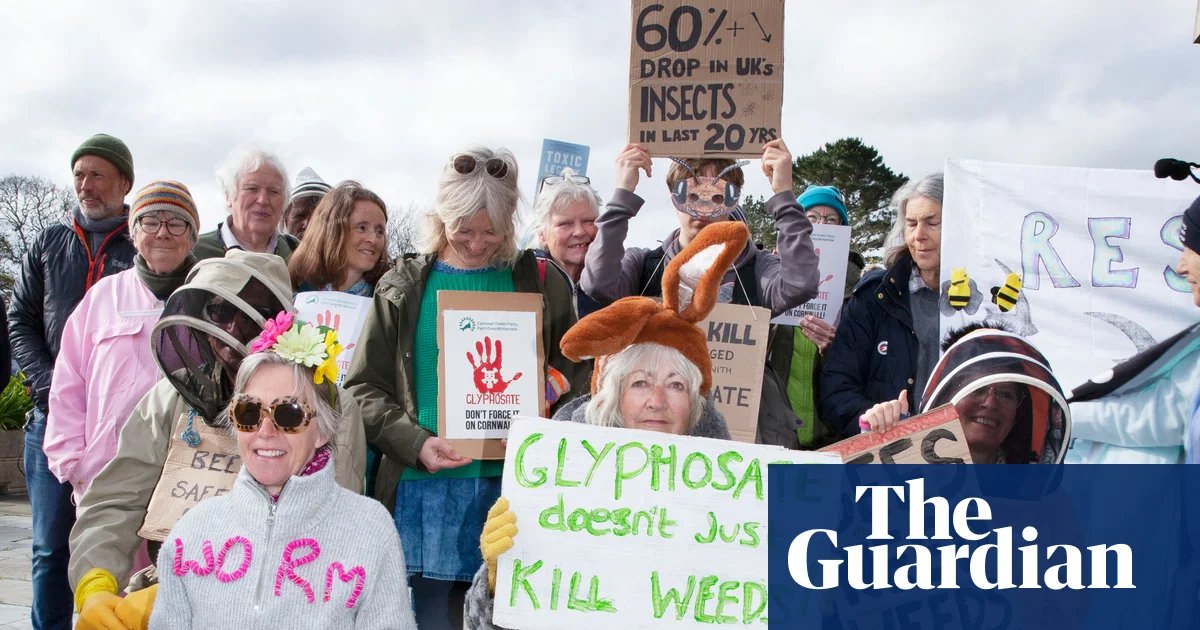
Thousands of people have signed petitions against the scheme and on Tuesday dozens of protesters converged on county hall in Truro for a demonstration before a meeting at which the issue was debated.
They claimed using the herbicide could put people and animals, particularly bees, at risk and harm beloved beauty spots including the surfing beaches of the north and winding river systems of the south.
In addition, many argued that the council cabinet, run by the Liberal Democrats and independents, was misguided to target weeds, claiming there was huge value in the humble dandelions, daisies and wild garlic that could be eradicated.
“It’s a retrograde step. I’m furious,” said Nichola Andersen, a beekeeper, who turned up in her protective suit and held up a sign reading “Bees need weeds”.
Another beekeeper, Oliver Baines, said: “Other places across the country are moving away from glyphosate. We’re going the opposite way. Anyway, they aren’t weeds – they are wildflowers and the bees love them.”
Lesley Fitt, who was wearing a gas mask to make her point, said: “The dangers of glyphosate are well known. Nature needs weeds. They’re an important part of the cycle of life.”
Marianne Daysh sported floppy ears to highlight her belief that glyphosate could harm mammals such as rabbits and hedgehogs. She said: “My grandchildren pick wildflowers for me. What if they’re covered in weedkiller?”
Some smaller Cornish councils have said they will go it alone and find other ways of tackling weeds. The town council in Penryn, near Falmouth, plans to organise groups of volunteers to keep the pavements clear without using glyphosate. Redruth town council is aiming for the same sort of community effort and one resident has suggested a “community goat” might help keep unwanted vegetation down.
Two petitions against the glyphosate scheme have collected more than 10,000 signatures and 200 health professionals signed a letter expressing at use of the herbicide near schools and healthcare settings.
During the full council meeting in front of a packed public gallery, Drew Creek, a Green councillor in Newquay, called the plan a “significant policy reversal” and asked for it to be paused. He said the World Health Organization had listed glyphosate as a probable human carcinogen since 2015.
Creek argued surface water run-off from treated areas may find its way into watercourses that ultimately discharged into the sea, including in the area he represents, the surfing town of Newquay. “I don’t want my children splashing around in this,” he said.
The UK government has stressed the virtues of moving away from chemical pesticides, and the Health and Safety Executive is assessing whether glyphosate should still be authorised for use in Great Britain.
But during the meeting, the portfolio holder for transport on the cabinet, Dan Rogerson, said a “limited reintroduction” of glyphosate was needed as routine weeding had not taken place for years.
He said the cabinet understood the concerns about public health and the environment but getting rid of weeds was not just about appearance but about public safety. A diluted solution would be applied using “targeted droplets” rather than spray and it would not be used on verges or green spaces, he said.
The council leader, Leigh Frost, said other local authorities in England and Wales had tested the “mixed method” of using diluted glyphosate and mechanical and manual weeding, and thousands of people complained at the state of pavements and kerbs.
In a report on the issue, council officers said a wide range of non-chemical methods had been trialled but these could not maintain Cornwall’s 1,000 miles of urban roads effectively on their own. They said a three-year “tightly controlled recovery phase” was required and would have a “negligible impact on pollinator habitats”.
The report said: “National regulators currently allow glyphosate to be used in the UK, and evidence indicates that when it is applied carefully, in a targeted way and only on hard surfaces, public exposure – and therefore health risk – is very low.”
In the end, councillors voted in favour of Creek’s motion calling for a pause – but it is only an advisory decision and it will now be up to the cabinet to decide whether to press on with the programme or halt it.
Loic Rich, the portfolio holder for environment and climate change, suggested the cabinet may change course. He said: “It’s an advisory but it would be morally wrong of us to ignore such a clear message. Over the next day or two we’ll be reflecting on what happened.”

