Trump’s order on psychedelics could have far-reaching science consequences
A new executive order could make it easier for researchers studying how psychedelic drugs such as psilocybin, LSD and ibogaine may be useful in medicine
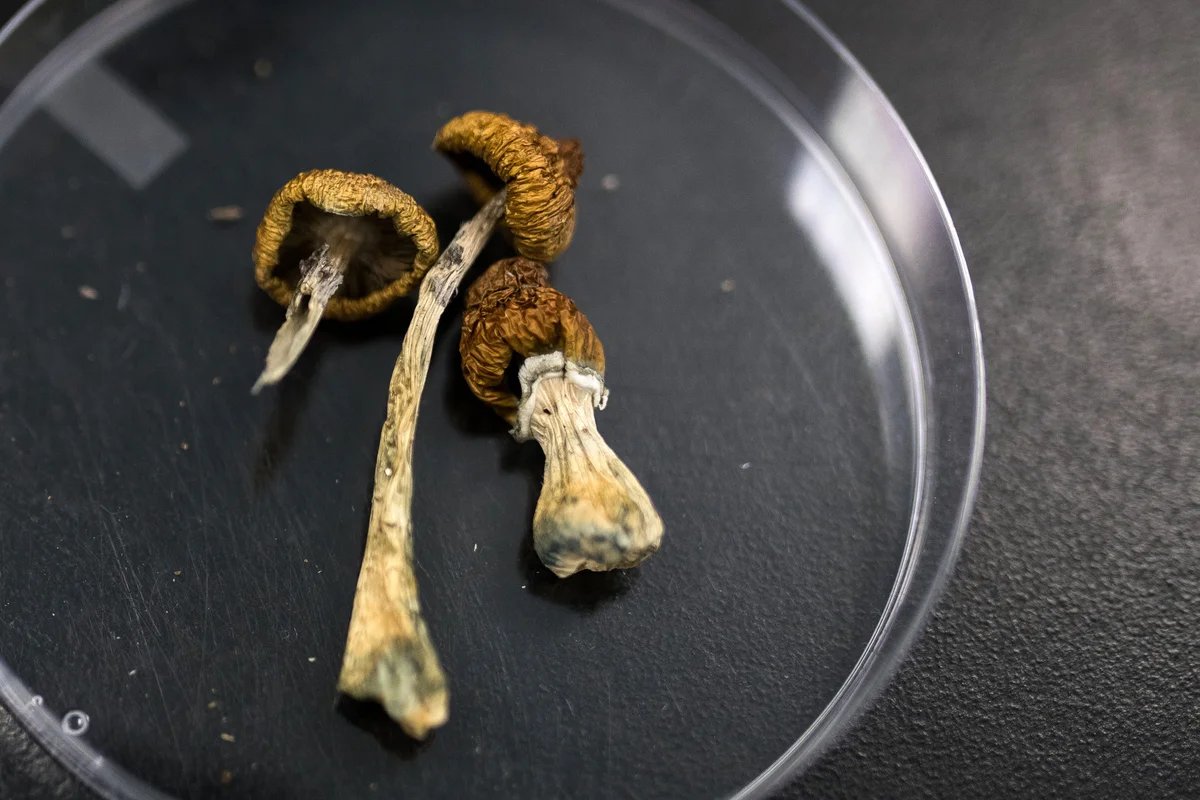
Psilocybe mushrooms at a lab in British Columbia in 2021.
James MacDonald/Bloomberg/Getty Images
President Donald Trump’s recent executive order to accelerate research on psychedelic substances and their potential to treat mental health conditions could have wide-ranging science consequences. Experts say the directive could expedite studies on how psychedelic and hallucinatory drugs such as MDMA, psilocybin, LSD and ibogaine may be useful in medicine.
The executive order is “timely,” says Frederick Barrett, director of the Center for Psychedelic and Consciousness Research at Johns Hopkins University. “If this executive order can help us to really push forward promising therapies more quickly, then I think that is a good thing,” he says.
The order directs the administration to promptly evaluate and possibly approve psychedelics for medical purposes, which could also make it easier for researchers to study these substances. It also calls for allocating $50 million to support states’ psychedelic research, including on ibogaine, a compound found naturally in a Central African plant. Some early research suggests that ibogaine could help treat depression and substance use disorders in some people, but it has been shown to have serious side effects.
On supporting science journalism
If you’re enjoying this article, consider supporting our award-winning journalism by subscribing. By purchasing a subscription you are helping to ensure the future of impactful stories about the discoveries and ideas shaping our world today.
An estimated 15.4 million adults in the U.S. live with severe mental illness, according to the National Institutes of Health. Veterans are at particular risk: Research shows that suicide rates are nearly twice as high among veterans as they are in the general population. And existing drugs, such as selective serotonin reuptake inhibitors (SSRIs), that are designed to treat depression and other mental health conditions aren’t always effective or accessible for everyone. An increasingly vocal cadre of researchers believe psychedelic substances could offer more effective treatments. And in some clinical trials, psilocybin, MDMA and LSD have been found to have promising results in treating mental health conditions.
“We need better treatments,” says Alan Davis, director of the Center for Psychedelic Drug Research and Education at the Ohio State University. “We need to be able to help people, and I think psychedelic therapies will offer a new way in which to do that.”
But research into these drugs is slow and hard to do, not least because the U.S. government categorizes many psychedelics as Schedule I drugs, which means they are considered to be dangerous and to have a high potential for abuse and “no currently accepted medical use,” according to the definition in the Code of Federal Regulations. In most cases, the possession of such drugs is federally criminalized, and that adds significant hurdles for researchers who are trying to study their effects.
That’s part of the reason why very few therapies that use psychedelic drugs have been approved for use in the U.S. One of the most well studied psychedelics, MDMA, was set back in 2024 when, citing insufficient and flawed research, the Food and Drug Administration rejected a proposal to approve it as a treatment for post-traumatic stress disorder.
An FDA approval for one of these drugs would make further research “much less difficult” for scientists, Davis says. “You would change the requirements involved, which means we could do a lot more research for a lot less money on those treatments.”
He hopes that the executive order signals a change in the government’s approach. “It is really quite remarkable that a sitting president has made this statement as part of official executive orders,” Davis says.
“That act, in and of itself, is, I think, going to really escalate the research in this space,” he adds, “and hopefully make these treatments available to people that need them as quickly as possible.”
It’s Time to Stand Up for Science
If you enjoyed this article, I’d like to ask for your support. Scientific American has served as an advocate for science and industry for 180 years, and right now may be the most critical moment in that two-century history.
I’ve been a Scientific American subscriber since I was 12 years old, and it helped shape the way I look at the world. SciAm always educates and delights me, and inspires a sense of awe for our vast, beautiful universe. I hope it does that for you, too.
If you subscribe to Scientific American, you help ensure that our coverage is centered on meaningful research and discovery; that we have the resources to report on the decisions that threaten labs across the U.S.; and that we support both budding and working scientists at a time when the value of science itself too often goes unrecognized.
In return, you get essential news, captivating podcasts, brilliant infographics, can’t-miss newsletters, must-watch videos, challenging games, and the science world’s best writing and reporting. You can even gift someone a subscription.
There has never been a more important time for us to stand up and show why science matters. I hope you’ll support us in that mission.