
British Jews feel under siege and worried about their children displaying religious symbols in public, community leaders have said.
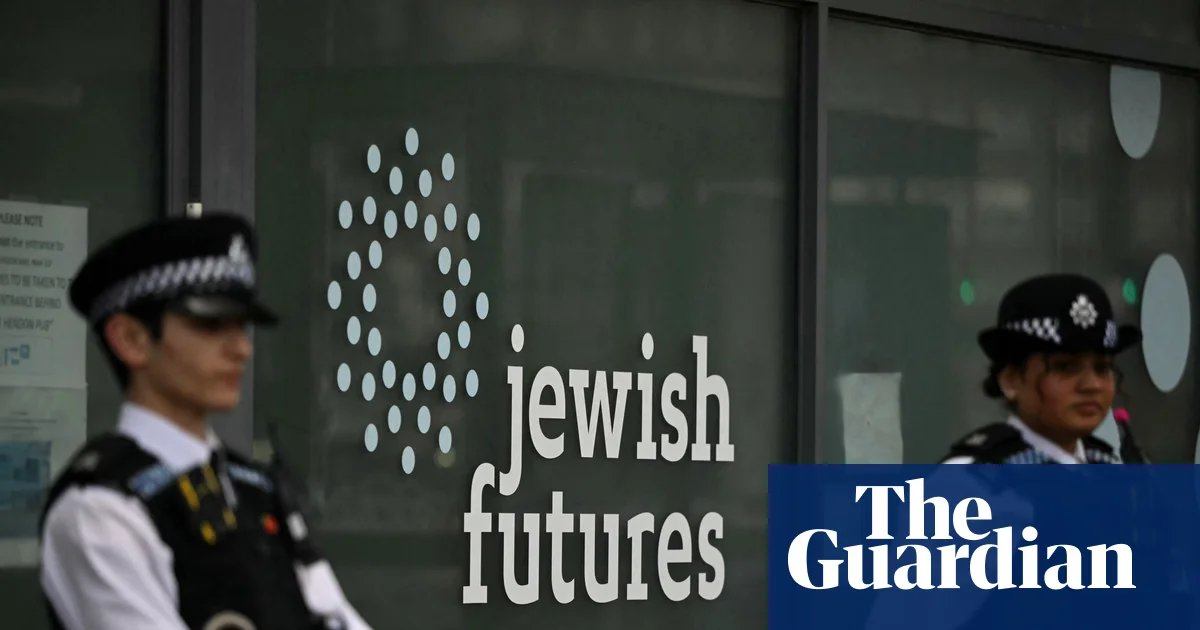
There have been a series of attempted arson attacks at Jewish sites over the past week, including incidents at two synagogues in London and one at a building used by the charity Jewish Futures. Four Jewish community ambulances were also set on fire in north London in the early hours of 23 March.
Parents are picking children up from stations, fearing drop offs at nurseries and schools, and choosing universities based on safety rather than academic fit. Some avoid wearing religious or Hebrew symbols, while many think twice before attending large Jewish events.
“Suddenly you look back and realise how much our lives have changed,” said Rabbi Charley Baginsky, co-chair of Progressive Judaism.
Baginsky does not let her children go out wearing clothes with Hebrew lettering, whether to go to central London or to walk the dog. “They wear things around their necks. I am really conscious of it. I haven’t told them not to, but do I go and meet my child from the train and walk back with them if they’re on their own? Yes. I probably wouldn’t have done that a year ago.”
Increased fear in the Jewish community comes as new data from the Institute for Jewish Policy Research (JPR) shows 742 people emigrated to Israel from the UK in 2025 – the highest annual total in more than 40 years, though the organisation said this did not amount to an “exodus”.
Dr Jonathan Boyd, JPR’s executive director, said: “Migration to Israel has remained strikingly stable over two decades, and even the elevated figures seen in 2025 fall well within a narrow historical range.”
But he warned that since the Hamas attacks on Israel in October 2023, more British Jews were reassessing what the future holds in the UK, “not because they are rushing to leave, but because rising antisemitism, recurring shocks and a growing sense of conditional security are reshaping how people think about belonging and long-term viability”.
Antisemitic incidents in the UK have increased significantly since the 7 October attacks and Israel’s war in Gaza, according to research by the Community Security Trust (CST), which provides security and support to Jewish communities in the UK.
The CST identified 3,700 incidents in 2025, the deadliest of which was the October 2025 terrorist attack on the Heaton Park synagogue in Manchester, in which two people were killed and three seriously injured.
Baginsky stressed it was a mistake to describe recent attacks as simply a Jewish issue. “This is a British problem,” she said. “Let’s start talking about what is happening in society. Places of worship and people of faith are not safe.”
Downing Street has condemned the attacks and vowed to introduce measures to protect the Jewish community. “[The prime minister] stands with the Jewish community, and he’s determined to do more to give them the security they deserve, and that is why we’re providing record levels of protective security funding as well as decisive steps to counter extremism and root out antisemitism across public life,” Keir Starmer’s official spokesperson said on Monday.
Raphi Bloom, who sits on the managing board of Jewish Representative Council of Greater Manchester, remembered heading to Heaton Park synagogue on Yom Kippur, before getting a call telling him to stay away. “We feel under siege. We feel that the government has engaged in some very warm words, but the action has been far too slow in coming,” he said.
Bloom, who wears a star of David necklace, said he decided to take it off during a recent doctor’s appointment to look into a mole on his back. “I was scared that the doctor would tell me there was nothing wrong when there was,” he said.
Dave Rich, director of policy at CST, said there had been a substantial police response to the arson attacks, and the government had put into place long-term policy efforts to address rising antisemitism. He said: “It’s taken a while, and I think a lot of people in the Jewish community would probably say it’s taken too long to get here, but I think we are now in a situation where these policies to tackle the deeper underlying causes are starting to gather momentum.”


