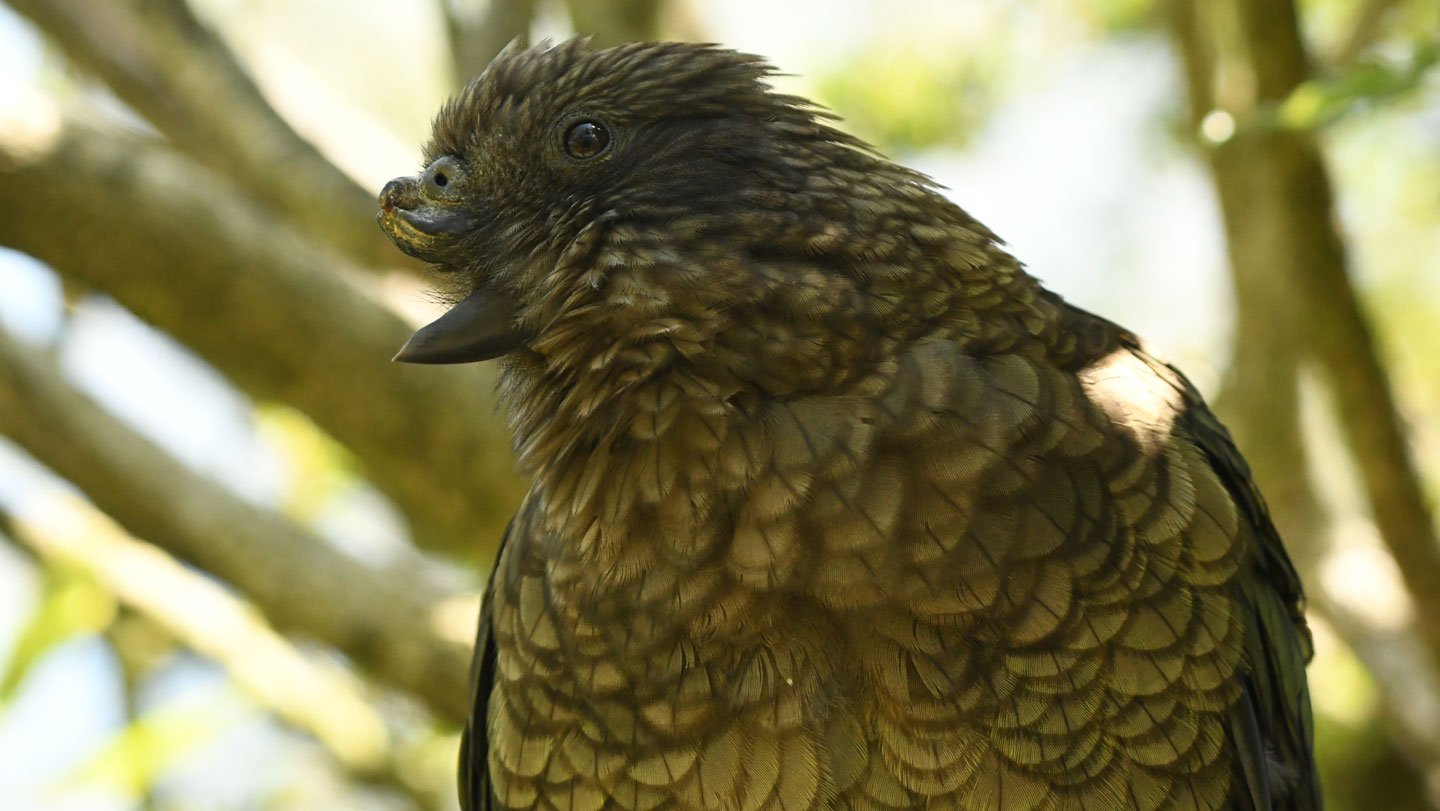
A parrot missing half his beak is top bird at New Zealand’s Willowbank Wildlife Reserve. The parrot, named Bruce, wins every fight with other kea parrots and gets priority access to food, researchers report April 20 in Current Biology. The finding challenges assumptions about how disability influences dominance in animal societies and shows that innovative behaviors can outweigh physical disadvantage.
Willowbank’s kea parrots live in a large aviary with trees and a stream. When visitors stop by, they often fail to notice the birds snoozing among the leaves. But when they spot Bruce, they always make the same comment, says Alex Grabham, a behavioral ecologist at the University of Canterbury in Christchurch. “Look at that poor bird.”
The visitors’ pity is misguided, Grabham says.
He and colleagues profiled Bruce’s social interactions with his flock (technically called a circus, reflecting the kea’s playful nature). Like other parrots, kea have a social hierarchy, determined through dominance interactions such as fighting, squawking or puffing up feathers.
Grabham’s team recorded 162 physical dominance interactions between the nine males in Bruce’s circus over four weeks. Bruce won all 36 of his interactions. He was indisputably the top kea.
And he is the first disabled animal to be recorded achieving a top status within a group without support from an able-bodied ally. (Faben, an alpha male chimpanzee living at Gombe National Park in Tanzania, lost his top rank after polio paralyzed his arm. He later achieved beta male status after perfecting a charging technique to bat away rivals and through forming an alliance with his brother, who replaced him as alpha male.)
An unusual combat technique was also key to Bruce’s success. While other kea tended to rely solely on kicking to repel other birds, Bruce supplemented his kicks with a unique jousting technique that exploited his exposed lower beak. Grabham’s team filmed 109 additional agonistic encounters between Bruce and other birds. During these, Bruce kicked slightly more than he jousted, but the latter attack was much more effective, repelling his opponent 73 percent of the time, compared with just 48 percent when he kicked.
Bruce’s lofty social position comes with perks. Other male kea preen Bruce, helping him clean parts of his beak he cannot reach. This behavior is highly unusual among kea, which normally preen only their mates. The lower another male’s rank, the more likely they were to preen Bruce. This behavior mimics hierarchical grooming seen in chimpanzees.
Lower-ranked birds also gave Bruce first dibs on food. The circus’s food was spread mostly between four central feeders. Over the four weeks that Grabham’s team analyzed Bruce, he ate first at those feeders 83 percent of the time. On four days, the other birds gave Bruce 15 minutes of uninterrupted alone time with all four feeders before eating his leftovers.
In many animal societies, top status comes at a cost. “An animal that is high up in the dominance hierarchy has to defend that position constantly,” says Amalia Bastos, a comparative psychologist at the University of St Andrews in Scotland who previously studied Bruce. Alpha male baboons, for example, show higher levels of stress metabolites called glucocorticoids.
Grabham’s team measured glucocorticoids in the birds’ droppings. Bruce, it turns out, was the most chill kea in the circus. It isn’t yet clear why, but Grabham thinks that Bruce is so dominant that other kea don’t mount any serious challenges to his throne. “He knows that he isn’t going to be followed around and beaten up or bullied or chased,” Grabham says.
It’s unclear whether Bruce would have thrived in a wild circus to the same degree he has at Willowbank. Bastos points out that with his damaged beak, Bruce might struggle with tougher foods during the winter. Furthermore, most kea circuses are fluid in their hierarchy, as birds join and depart groups throughout the year. For now, in Willowbank’s strict hierarchy, Bruce is the boss.
This isn’t the first study to show Bruce is capable of innovation. In 2021, researchers reported on his self-preening technique. He uses pebbles to clean his feathers. “Bruce has now shown twice that being different is not necessarily disadvantageous,” Bastos says.