NASA’s Artemis II moon mission just committed to leaving Earth orbit
The Orion spacecraft just completed its last planned major fuel burn, setting its course for the rest of its ten-day journey around the moon and back
NASA has launched four astronauts on a pioneering journey around the moon—the Artemis II mission. Follow our coverage here.
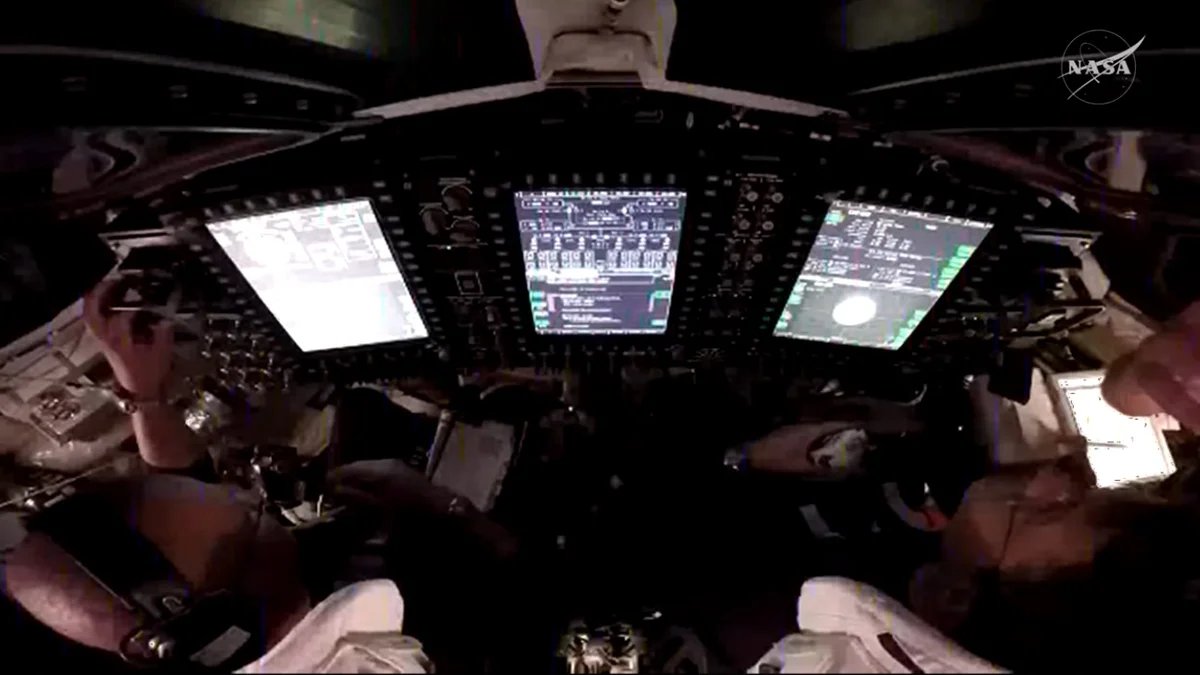
NASA’s Artemis II moon mission is on track to loop around our nearest satellite and back. On Thursday, around 7:50 EDT, the Orion spacecraft’s main engine, the European Service Module, ignited and jettisoned 6,700 pounds of monomethyl hydrazine propellant over the course of about six minutes. The “translunar injection burn” shoved the craft onto its correct path with 6,000 pounds of thrust—about the same as to accelerate a car from 0 to 60 miles an hour in 2.7 seconds—increasing its speed by 867 miles per hour.
“When the engine ignites, you embark on humanities lunar homecoming arc, and set the course to return Integrity and her crew safely home,” said Houston Mission Control immediately before the burn. “Houston is go for TLI.”
“Integrity copies—your Integrity crew is go for TLI,” replied astronaut Christina Koch. “With this burn to the moon we do not leave Earth, we choose it.”
On supporting science journalism
If you’re enjoying this article, consider supporting our award-winning journalism by subscribing. By purchasing a subscription you are helping to ensure the future of impactful stories about the discoveries and ideas shaping our world today.
Following the burn, the crew is “healthy” and the Orion spacecraft is “performing really well,” said Lori Glaze, the acting associate administrator for NASA’s Exploration Systems Development Mission Directorate, at a press conference Thursday night. The burn was “flawless,” Glaze said. NASA isn’t tracking anything of concern at this point.
Ahead of the maneuver, the four-person crew—astronauts Reid Wiseman, Victor Glover, Christina Koch and Jeremy Hansen—performed a series of system checks to prepare. At the time of the burn, the spacecraft was just 115 miles above Earth.
Their work puts the Artemis II hurtling towards the moon at a blistering 22,670 mph—the fastest it will go at any point in space. At the time of writing, the moon remains about 246,000 miles away; it will take Orion almost three days to enter the moon’s sphere of influence, where its gravitational pull on the craft becomes stronger than Earth’s.
This trajectory allows Orion to slingshot around and back to Earth, meaning the return trip likely won’t need another large burn and the spacecraft should splashdown on April 10. However, there will be a couple of small planned fuel burns to stay on track over the next few days.
Now that this critical burn is complete, the crew will be more free to conduct experiments and, possibly, speak to their families. “They’ve been really busy,” NASA flight director Judd Frieling said at the same press conference, adding, “we’ll make time for that now that we’re past TLI.”
The Artemis II crew will spend the rest of their journey to the moon testing life-support systems and rehearsing for when they’ll finally be over the lunar far side on Monday. That day, they will have a brief window to observe lunar features never seen by human eyes and take photographs and video. On that day, they’re also poised to go further than any human has ever traveled from Earth. Then, after their moon-assisted U-turn, the astronauts will begin the long trek home. The crew is scheduled to splash down in the Pacific Ocean at around 5:30 P.M. on April 10.
Additional reporting by Jackie Flynn Mogensen
It’s Time to Stand Up for Science
If you enjoyed this article, I’d like to ask for your support. Scientific American has served as an advocate for science and industry for 180 years, and right now may be the most critical moment in that two-century history.
I’ve been a Scientific American subscriber since I was 12 years old, and it helped shape the way I look at the world. SciAm always educates and delights me, and inspires a sense of awe for our vast, beautiful universe. I hope it does that for you, too.
If you subscribe to Scientific American, you help ensure that our coverage is centered on meaningful research and discovery; that we have the resources to report on the decisions that threaten labs across the U.S.; and that we support both budding and working scientists at a time when the value of science itself too often goes unrecognized.
In return, you get essential news, captivating podcasts, brilliant infographics, can’t-miss newsletters, must-watch videos, challenging games, and the science world’s best writing and reporting. You can even gift someone a subscription.
There has never been a more important time for us to stand up and show why science matters. I hope you’ll support us in that mission.