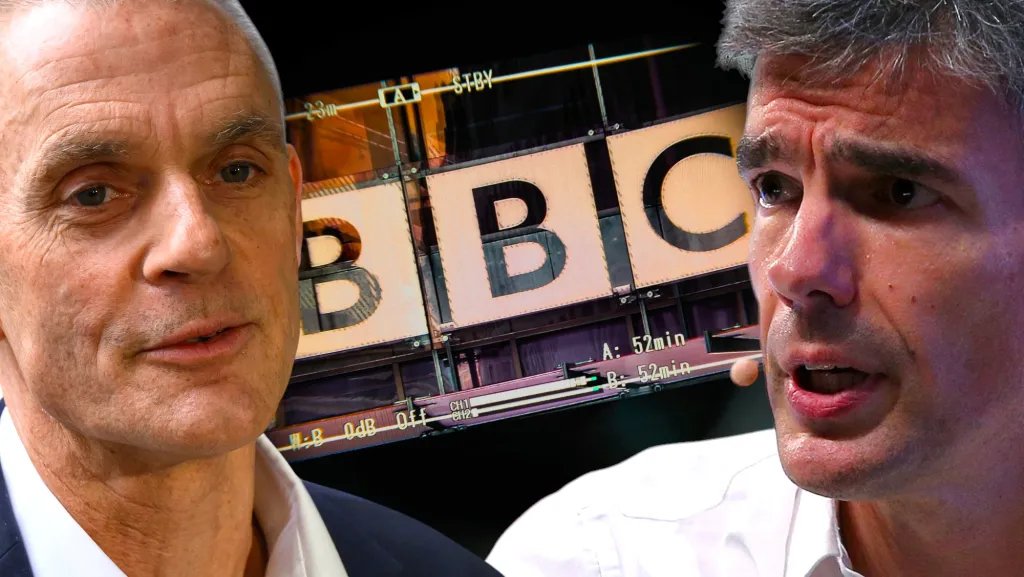
If Matt Brittin needs a measure of insight about the pressures he’s agreed to shoulder, the incoming BBC director general needs only read the valedictory speech of his predecessor. Speaking to luminaries of the Royal Television Society (RTS) earlier this month, Tim Davie revealed how he would use his neighbor’s garden as an escape hatch when Britain’s media were assembled outside his front door during times of crisis.
One of Davie’s closest allies says only two other jobs in British national life match the scrutiny that comes with running the BBC: being prime minister and managing the England football team. Ultimately, it proved too much for Davie, and a preventable scandal over a poorly edited Donald Trump speech was the final straw. Davie resigned last November, though it was not the first time he considered quitting. He nearly left after the BBC live-streamed Glastonbury act Bob Vylan chanting “death to the IDF,” sparking a deafening commotion about alleged hate speech.
The BBC’s critics, and there are many of them, will say that he was right to fall on his sword. But ultimately, Davie did leave on his own terms. The BBC board was shocked and disappointed by his resignation. His departure was in no way celebrated by employees, many of whom are quick to condemn management at the best of times. Indeed, those who spoke with Deadline expressed regret at his decision. Not all BBC directors general are afforded this luxury.
Davie’s speech to the RTS framed his legacy and the issues facing the BBC in 2026. The institution remains a global brand that commands respect and affection, but it is under siege from ideological enemies, chastening financial pressures, and overseas tech titans. Davie described these forces as “jeopardy” (so much so, UK media journalists would play “jeopardy” bingo when he spoke) and the word made an inevitable appearance in his final public address.
Deadline has spoken to senior insiders about three key themes in the speech, reflecting on the job completed by Davie on his final day at the BBC, as well as the task ahead for Brittin, who takes over on May 18. Sources were interviewed on the condition of anonymity because they were not authorized to speak to a journalist.
Impartiality
“Impartiality has been a priority. In an age of polarization and culture wars, this has been the toughest thing to manage during my tenure.” — Tim Davie, RTS speech
Davie foregrounded impartiality in literally his first internal address as director general in September 2020, telling staff that they “should not be working at the BBC” if they wished to spout their views. “We urgently need to champion and recommit to impartiality,” he said, before going on to introduce strict new social media rules.
Davie would often talk about impartiality in existential terms, so it is ironic that the scandals that broke his joy for the job were ultimately linked by spittle-flecked allegations of bias. War in the Middle East and the re-emergence of Trump are deeply polarizing, and when the BBC makes mistakes — as it did at Glastonbury and with Panorama’s edit of Trump’s January 6 speech — they are seized upon and amplified. “Everyone is looking to ascribe intent, even when there is none,” is how a top BBC insider describes the atmosphere.
In his RTS address, Davie put it this way: “I remember seeing myself on a bus stop advert condemning me for being an Israeli government sympathiser having just read an article expressing outrage at my pro-Palestinian bias.”
Donald Trump
Even some of Davie’s closest colleagues acknowledge that impartiality is an unwinnable issue for the BBC. One adviser says the social media rules, introduced when a hostile Boris Johnson government was in power, were a “rod for the BBC’s back,” leading to regular clashes with employees and freelance presenters, including Emily Maitlis and Gary Lineker, both of whom left the BBC. “There was sound logic. It was more a problem of practical implementation,” the adviser adds. A friend of Davie, who does not work for the BBC, says the policy threw too much “red meat” to the BBC’s enemies.
Another signature initiative, the fact-checking news service BBC Verify, is routinely vilified by right-wing news outlets. Launched by Deborah Turness, the ex-BBC News chief who quit amid the Trump debacle, Verify now faces an uncertain future without her support. Newsroom insiders are intrigued by Brittin’s views on Verify, with some predicting that he will visit the team as part of his onboarding process over the coming weeks.
A former BBC board member sums up the impartiality conundrum like this: “The risk of putting impartiality at the top of your agenda is, when the BBC fails, it looks like the director general has failed.” Ultimately, most BBC top brass acknowledge that the corporation has little choice but to routinely restate its commitment to neutrality. Whether Brittin decides to put it at the heart of his mission is another matter. Unlike Davie, he did not use the word “impartiality” in the press release announcing his appointment.
Finances
“We have had to take tough choices to cope with a frankly brutal financial situation.” — Tim Davie, RTS speech
Davie’s last act as director general was to oversee the BBC’s response to the government consultation on charter renewal. The submission is, in effect, a manifesto for its continued existence, and stakes out a case for why the BBC’s licence fee funding model needs to be reformed to boost the corporation’s coffers.
Some 94% of the UK population use the BBC every month, but fewer than 80% pay the £180 ($240) annual licence fee. The BBC wants to explore ways of compelling more people to contribute from 2028, including charging those who watch live content on other streamers, such as Netflix. In the meantime, the BBC needs to save £500M over the next couple of years, which is on top of its existing £1.5B cost-cutting plan.

The BBC’s London headquarters
Getty
Brittin can expect to make some “difficult decisions” when he takes office, a statement repeated four times in the BBC’s annual plan, published last week. Significant work is already underway to save £100M by reimagining the BBC’s workforce through outsourcing thousands of jobs and commercialising online teams under BBC MediaTech, the latter of which was touted in Davie’s speech.
Davie has been a quietly radical DG when it comes to cost-cutting. He had little choice. “Few organizations survive losing a third of their budget,” says the adviser. Davie has waved goodbye to around 2,000 employees (by contrast, headcount grew under his predecessor Tony Hall), though he has eschewed closing legacy broadcast networks when switching resources to digital, perhaps mindful of the inevitable backlash that follows.
Others think Davie’s ruthless headcount reductions led to a brain drain, which in turn precipitated editorial errors that ultimately led to his resignation. “The organization became overstretched due to repeated staffing cuts,” says a senior insider. “As a result, the BBC lost control over editorial judgments, and Tim meddled in decisions without good judgment.”
This person says Davie surrounded himself with commercial executives, rather than those steeped in public service broadcasting. Half of the BBC’s executive committee joined the corporation from the private sector on Davie’s watch. This is further reflected on the BBC’s board, where insiders feel a deft editorial hand was missing when the Trump scandal blew up (content chief Charlotte Moore was gone and not replaced on the board). Course correction is coming, with the board and Brittin, himself lacking editorial credentials, committed to hiring a deputy director general with content and journalism expertise.
Culture
“We have led the industry in creating a culture that we can be proud of. We have had some tough things to do in this area, flushing out deep issues.” — Tim Davie, RTS speech
Speak to senior people at the BBC, and they will tell you that one of Davie’s crowning achievements is unseen, often intangible, cultural transformation. “He got rid of toxic, difficult blockers of change,” says one person, who worked with Davie closely. Another recalls: “He would despair sometimes at not being able to get the BBC to move fast enough [on cultural change]. He would literally throw his hands in the air.”
One experienced newsroom figure expects this to intensify under Brittin. “One under appreciated thing, [is that he is the] first DG in history who has no professional attachment to any part of BBC. Some of those who’ve made a career holding on to power over enabling change might want to be nervous,” this person said.
Scott Mills
Getty
Davie was not known as “Tigger Tim” for no reason. Whereas Tony Hall used to run the BBC like a “medieval court,” says one unflattering insider, Davie worked open plan, often spontaneously walked the building, and genuinely relished visiting BBC outposts. Co-workers say he cares about “kindness,” which is why he has spent recent months trying to purge the BBC of alleged power abusers, like former MasterChef co-host Greg Wallace. It’s an apparently never-ending task, with a fresh scandal emerging this week over Scott Mills, the Radio 2 presenter who was fired over historical sexual abuse allegations.
A high-ranking editorial executive says Davie would confront “difficult conversations” on issues like Gaza, speaking to staff and navigating their concerns with some success. “Very smart people will tell you, with incredible intellectual flourish, why you are wrong,” a senior insider says of internal unrest. “The DG gets an enormous amount of pressure, and I guess the only downside of being willing to listen to everyone, is being willing to listen to everyone,” says the editorial executive, suggesting this sometimes clouded Davie’s better judgment.
Davie got the job partly because he showed that he could manage a crisis during an interim spell in charge in 2012, when the Jimmy Savile scandal engulfed the BBC. So it’s something of an irony that crises got the better of him, with the BBC accused of being flat-footed on Trump, the BAFTA N-word debacle, Glastonbury, and Gaza: How to Survive a Warzone, the film narrated by the child of a Hamas minister.
A well-placed employee explains: “He’s a great communicator, very driven and passionate, and a good strategic thinker. But he doesn’t read his briefing papers, doesn’t listen to feedback, and tries to juggle too many plates at once. He excels at crisis management — crises often of his own making. I call him Captain Chaos.”
‘The Traitors’ host Claudia Winkleman
BBC/Studio Lambert
Above all, Davie was hyper-focused on the BBC’s relevance. It was not unheard of for the DG to walk the street, gesture towards members of the public, and ask colleagues if they were getting value from the corporation. He would say to allies that the BBC “can’t just be about eating your greens, or standing on a plinth and lecturing people about what they should be watching.” The corporation has to matter to people, has to be part of their lives, he would say. In this context, it’s no surprise Davie used his RTS speech to announce a three-year deal for The Traitors, a nation-binding hit, produced outside of London.
The signs are that Brittin feels similarly. “Now, more than ever, we need a thriving BBC that works for everyone in a complex, uncertain and fast-changing world,” the ex-Google man said in his first remarks after being appointed. The words could have been ripped from Davie’s final speech.