KENNEDY SPACE CENTER, Florida—For the first time in nearly 54 years, humans are on their way to the moon.
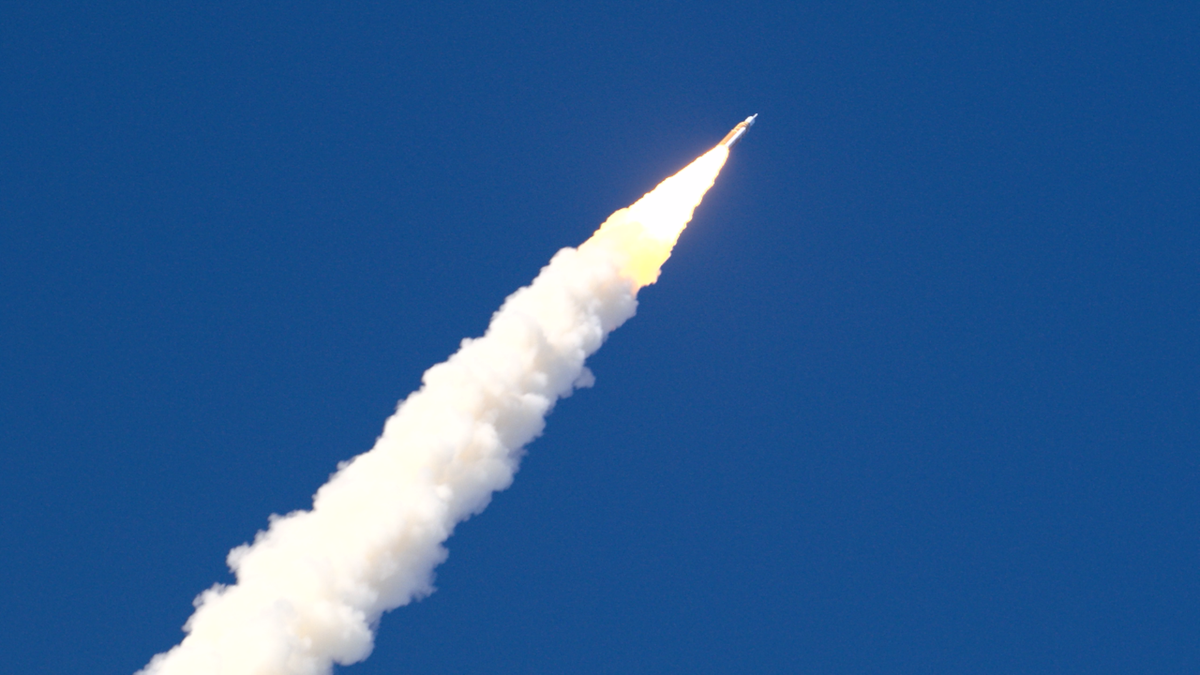
At 6:35 P.M. EDT, NASA’s Artemis II mission blasted off from Kennedy Space Center. It’s the second flight in the agency’s moon-focused Artemis program and the first with humans onboard. The hulking Space Launch System (SLS)—a 322-foot-tall rocket flanked by boosters emblazoned with a patriotic logo celebrating the 250th birthday of the U.S.—shook the earth as it leaped from the pad. The pyrotechnic performance attracted some 400,000 spectators to Florida’s Space Coast, and millions more watched online as Artemis II soared into history.
Now, tucked into the Orion spacecraft, four astronauts and a nation’s starry-eyed ambitions are on course for a fateful lunar rendezvous. They will not land on the moon. But across 10 days in space, the crew will follow a looping path that slings them well beyond the moon’s far side before it returns them to Earth. Artemis II is meant to be the first in a years-long series of crewed deep-space missions that, if successful, will realize the construction of a multibillion-dollar moon base at the lunar south pole sometime in the 2030s.
On supporting science journalism
If you’re enjoying this article, consider supporting our award-winning journalism by subscribing. By purchasing a subscription you are helping to ensure the future of impactful stories about the discoveries and ideas shaping our world today.
“We have a lot of ambitions for the moon,” Lori Glaze, acting associate administrator of NASA’s Exploration Systems Development Mission, tells Scientific American. “Our intent is to build that enduring presence on the moon and, in particular, at the south pole, where no one has ever been before. And the first step in making that happen is Artemis II.”
The mission debuts more than three years after the uncrewed Artemis I flight, and it has had a similarly rocky path to the pad. Much like its predecessor, Artemis II ultimately launched months after missing its initial February window, set back by propellant leaks and other issues with ground systems and the SLS—a rocket, built in part from vintage space-shuttle-era hardware, that’s now extremely overbudget. Amid those delays, NASA leaders revamped much of the Artemis program, although the Artemis II mission itself is unchanged. The program architecture now includes another crewed flight in the sequence, an increased cadence of missions to the moon and, in the future, a decreased reliance on the budget-busting and finicky SLS to get there.
The primary goal of Artemis II is to test the systems onboard the Orion spacecraft and ensure the capsule can support long-duration crewed missions. Like the crew of NASA’s Apollo 8 mission from 1968, the astronauts of Artemis II won’t reach the lunar surface; at closest approach, the Orion capsule will still be between 4,000 and 6,000 miles above the moon. Still, that’s the closest any human has come to our nearest celestial companion since the last crewed landing during the Apollo 17 mission in 1972.
“For the last 60 years, almost, more than a generation have not experienced people exploring beyond low-Earth orbit. That’s a big deal,” says Lori Garver, former deputy administrator at NASA. “To be getting back to that and to be doing it in a way that we hope leads to the kind of discoveries you can only get when you’re going beyond where we’ve been before—hopefully, most of us will agree that is important.”
Echoes of History
The parallels between Apollo 8 and today’s Artemis II go beyond any mere mission profile; both also launched in eras of remarkable global turmoil.
In the late 1960s, the U.S. was about as divided as it’s ever been since the Civil War. Nearly six decades ago the nation was riven by protests over the Vietnam War, the impacts of the widespread Civil Rights Movement, and the assassinations of Martin Luther King, Jr., and Robert F. Kennedy. Amid that upheaval, Apollo 8 took flight. On Christmas Eve in 1968, the crew participated in a live TV broadcast from lunar orbit. And by the time the spacecraft splashed down in the Pacific Ocean, its astronauts had snapped one of the space age’s most epochal images: “Earthrise,” in which our lonely aquamarine marble gleams above a barren lunar landscape.
“Earthrise,” photographed by Apollo 8 astronaut William Anders on December 24, 1968. Artemis II will deliver similar imagery, this time in high-definition and live streamed from deep space.
The crew received millions of telegrams after their return to Earth, but one in particular stood out: it said, “You saved 1968.” The cold-war-fueled space race with the Soviet Union, it seemed, had delivered a powerful moment of unity and inspiration in America—if not the entire globe.
“The trope that Apollo 8 ‘saved 1968’—which was a devastating year in the U.S. and around the world—I think that’s more easily seen in retrospect,” says Margaret Weitekamp, a historian and curator at the Smithsonian Institution’s National Air and Space Museum. “I’m going to be curious, as a scholar and a researcher, to see the impact and reception of Artemis II.”
Nearly 60 years later, the U.S. is again at a crossroads, embroiled in an unpopular war and with a polarized populace facing a potential economic downturn at home. And a second space race is unfolding, this time between the U.S. and China, which also harbors lofty lunar ambitions. Even the calendar conspires to draw comparisons: it’s not quite Christmas, but Artemis II’s astronauts will fly by the moon on Easter, another prominent day in the Christian calendar. As a nod to Apollo 8, the crew also chose a zero-g indicator inspired by the “Earthrise” image—a stuffed plushie named “Rise,” a smiling moon wearing a crescent Earth on a ballcap. It was designed by Lucas Ye, a third grader from California. The crew will know they’ve reached space when Rise floats in the cabin.
But despite the parallels, spaceflight occupies a very different place in the collective consciousness than it did during the Apollo era. “If there were a moment where spaceflight did have the power to mend societal factions, it would have been in 1968,” says Jordan Bimm, a space historian at the University of Chicago. “Space technology and exploration were this proxy for national prestige and national might during the cold war—it was this focus of urgency and geopolitical strategy. Today the technology that holds that place is artificial intelligence.”
Still, Bimm and others hope the Artemis II mission will capture imaginations in the same way as Apollo 8. It is, after all, the first time most of us will watch as humans return to the moon’s vicinity—although scholars note that overall public awareness of the Artemis II mission is much lower than for the Apollo flights, in part because “we are living in a booming space age that doesn’t necessarily pierce the public consciousness each time some Starlink satellites go up,” Weitekamp says.
But human spaceflight—and especially test flights—are different. “It takes some courage and daring to do that—to be the test pilots on a system like this,” says Clay Mowry, CEO of the American Institute of Aeronautics and Astronautics. “Every time you put humans into space, I get a knot in my stomach.”
A New Crew for a New Age
The four astronauts of Artemis II also reflect how spaceflight has changed since the 1960s, when having “the right stuff” meant being white and male—typically with a military background. Onboard are commander Reid Wiseman, pilot Victor Glover, mission specialist Christina Koch, and mission specialist (and rookie Canadian astronaut) Jeremy Hansen. It’s the first time a woman, a person of color or a non-NASA astronaut will go to the moon.
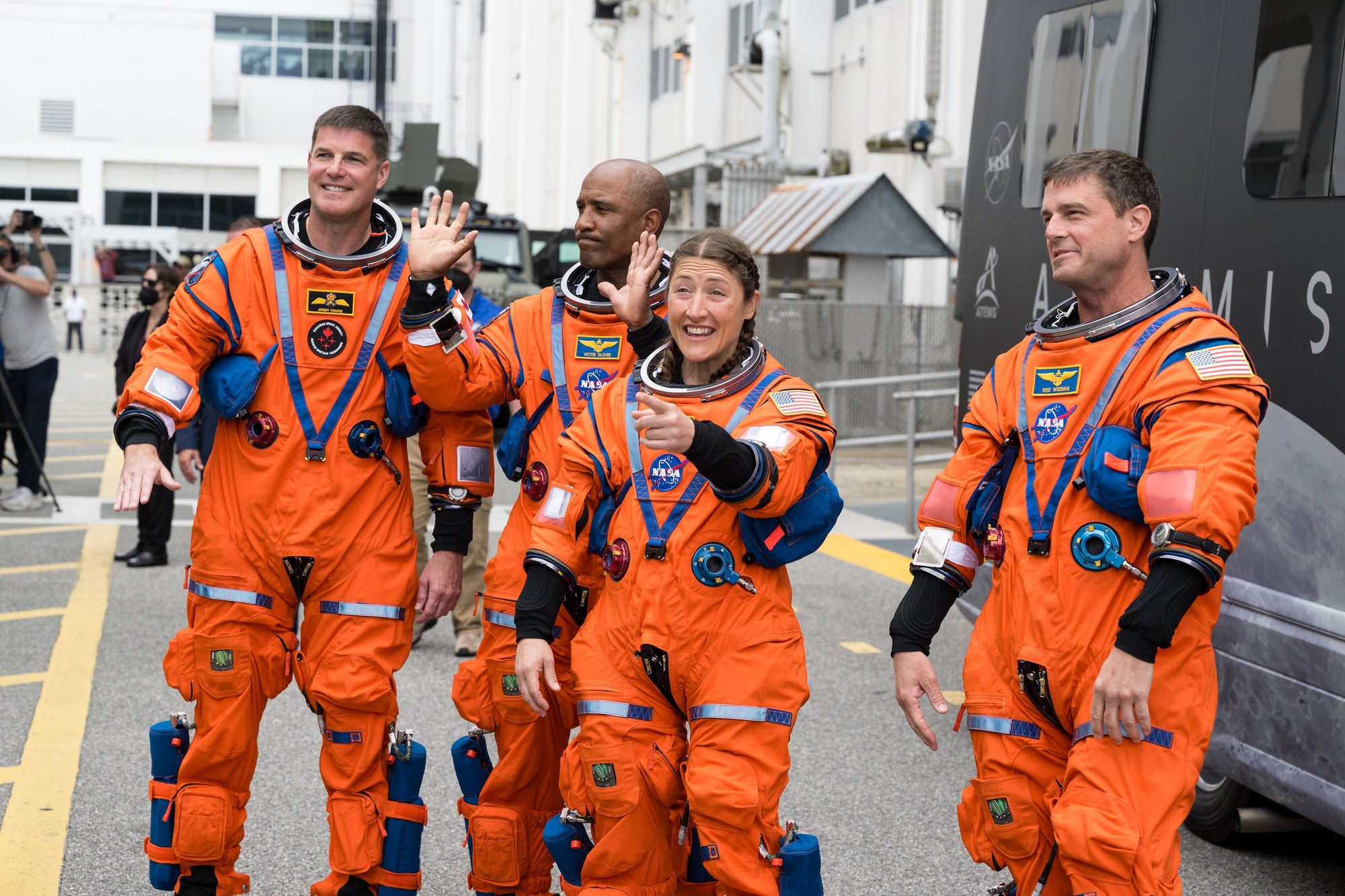
The crew of Artemis II waves to family and friends shortly before boarding their Orion spacecraft atop the SLS rocket. From right to left, they are: NASA astronauts Reid Wiseman, commander; Christina Koch, mission specialist; Victor Glover, pilot; and CSA (Canadian Space Agency) astronaut Jeremy Hansen, mission specialist.
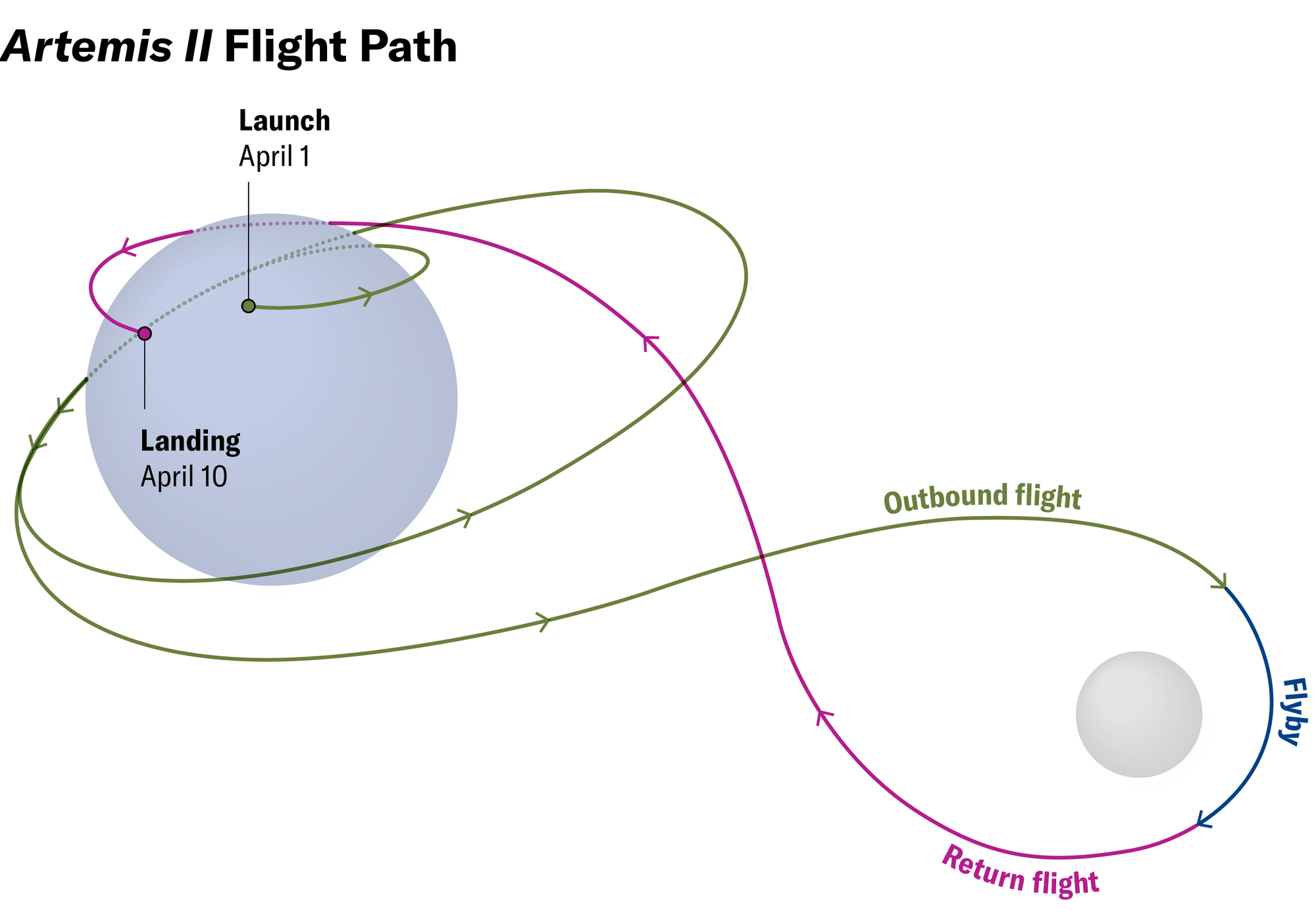
The mission’s flight path begins with two loops around Earth, which the crew will use to test the spacecraft’s flight capabilities and its onboard systems. The Orion capsule will then embark for the moon by firing its main engines in a “translunar injection burn” that will push it up and out from Earth orbit. From there, the spacecraft will follow a free-return trajectory around the moon, meaning that gravity alone will be sufficient to pull the capsule back to our planet, even if all the onboard thrusters fail. It will take about four days to reach the moon. Once the spacecraft arrives, its trajectory will take it far beyond the lunar far side before it loops back toward home, a path that should make the Artemis II crew the farthest-flung humans in history.
“If we do pass [that record]—and there’s no guarantee that we will—but if we do, we should celebrate the pioneers who came before us that put us in this position,” Hansen told reporters before the launch. “The point is not being the first; it’s making sure you’re not the last.”
During Artemis II’s six-hour lunar flyby, the moon will appear to be about the size of a basketball held at arm’s length. Through Orion’s view ports, the crew will be busy observing the moon—and may even see parts of the lunar far side for the first time with human eyes. “We have done a lot of training with them about the geology of the far side,” Glaze says. Just how much far side terrain the Artemis II astronauts will clearly see, however, depends on when they arrive during the complex cycle of sunlight and shadow that plays across the lunar surface as the moon orbits the Earth.
Amanda Montañez; Source: NASA (reference)
Koch is excited about another first: “We are going to be looking back at an Earth where not every human is on Earth. That is new, that is different,” she told reporters, referring to the astronauts currently onboard the International Space Station and China’s Tiangong space station. “I hope people … recognize the importance of that milestone.”
Once Artemis II leaves the moon behind, its flight back to Earth will take another four days —by design longer than Apollo-era return trips; this will allow the Artemis II crew more time to test all of Orion’s systems. The crew will also be conducting experiments to better understand the effects of deep-space voyages on human health.
One system that’s crucial for a safe return to Earth is Orion’s heat shield, which will protect the capsule and crew from lethal, searing temperatures during atmospheric reentry. The heat shield did not perform perfectly during Artemis I, although no hot gases damaged the crew cabin or onboard systems. When NASA inspected the heat shield after that reentry, the agency found disturbing “anomalies”—gaping cavities in the shield where chunks of protective material had unexpectedly cracked and broken off. Somewhat controversially, NASA opted to save time and money by flying the same heat shield design on Artemis II, even though the program’s future missions will use a different, newer version.
If all goes well, the crew will splash down off the coast of San Diego, Calif., some 10 days after launch.
The mission is “exciting for a whole new generation of scientists and engineers and people that didn’t experience Apollo,” Mowry says. “And I think it’s exciting all the way around to see us going back to the moon but with bigger goals—bigger science goals, bigger goals for humanity, bigger goals for off-planet work and living in space.”