For thousands of years, humans have prepared to plant by tilling, overturning the soil to manage moisture, airflow and nutrients. But modern agriculture’s deep plowing and heavy machinery do more harm than good, by disrupting the natural pathways through which water infiltrates, researchers report March 19 in Science. Breaking down that network isn’t just counterproductive to growing crops, the team says: It also makes the soil less resilient to flooding and drought.
To peer belowground, geophysicist Qibin Shi of the Chinese Academy of Sciences in Beijing and colleagues fashioned a dense array of seismic sensors out of fiber-optic cables. Fiber-optic cables aren’t just for high-speed internet; they are powerful tools for seismology, sensitive enough to detect even the tiny vibrations triggered by the movement of water through the soil.
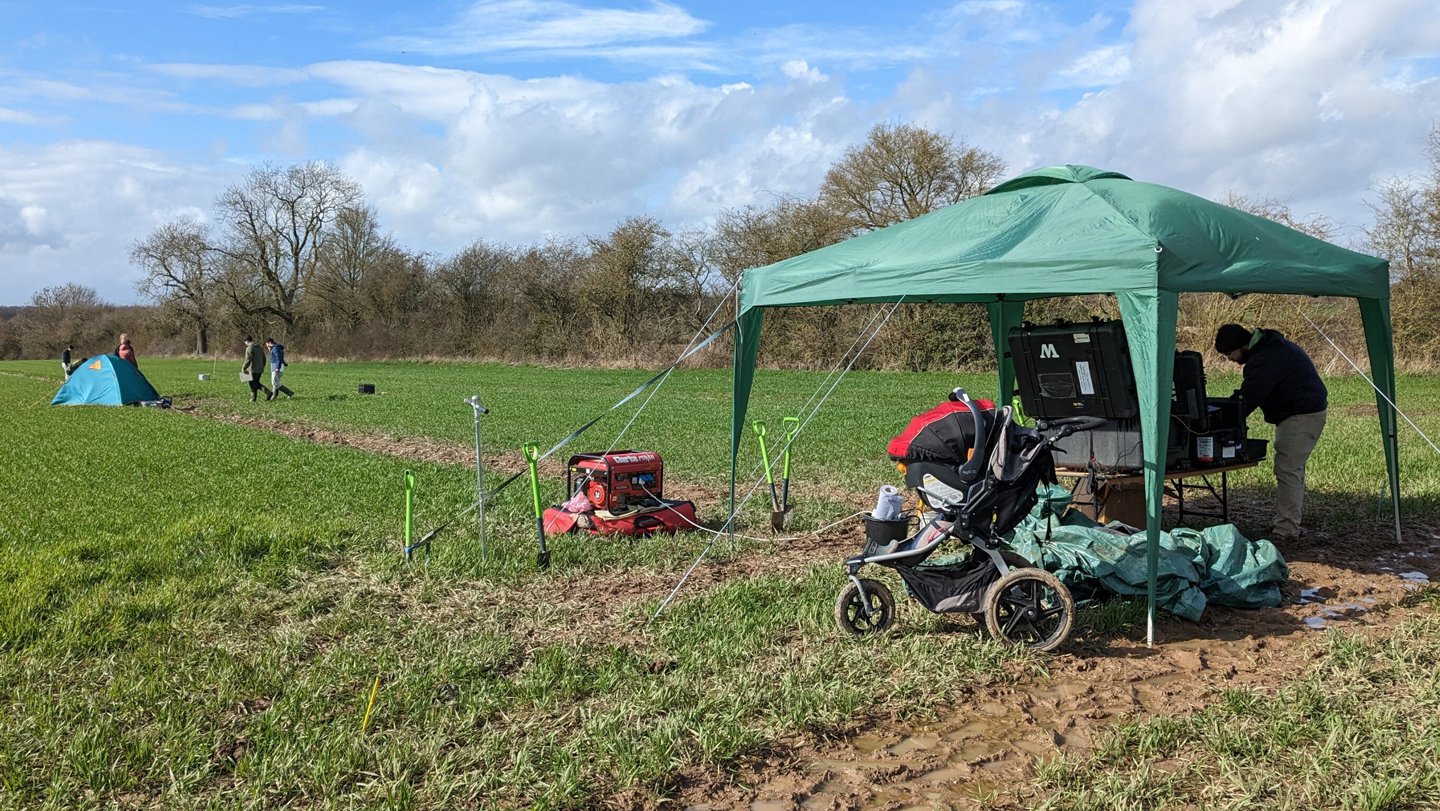
The team installed the cables along the boundaries of 27 plots of land at Harper Adams University’s test farm, an agricultural research site in Newport, England. For this study, the plots were prepared with different tilling depths: One-third were left untilled, one-third were plowed to a depth of 10 centimeters and the last third were plowed to a depth of 25 centimeters. Those thirds were further divvied up based on the weight of machinery used to till them, which affects ground compaction.
For three days in March 2023, the team collected continuous seismic data, tracking the soil’s response to rainfall. In soil worked to a greater depth and compaction, rainwater tended to pool near the surface rather than seeping downward. That also meant that the water evaporated swiftly in sunlight. The less-reworked the soil was, the more easily the water was distributed.
To understand the mechanics at work, the team devised a computer model that recreated those data. Rainwater, they found, moves through porous soil via dynamic capillary pressure. Because the tiny pathways between specks of soil are very thin, like blood vessels, water’s flow through them isn’t driven by gravity. Instead, it moves by capillary action, a push-pull between the water’s adhesion to soil particles and cohesion to other water molecules. When the pathways are disturbed or compacted, those suction forces get stronger, hampering the water’s movement.
Fiber-optic sensing offers a quick and inexpensive way for farmers to monitor soil moisture on a large scale, the team says. Such monitoring could also provide real-time warnings for natural hazards, including flooding and earthquake-induced liquefaction, when saturated ground can suddenly become unstable due to shaking.